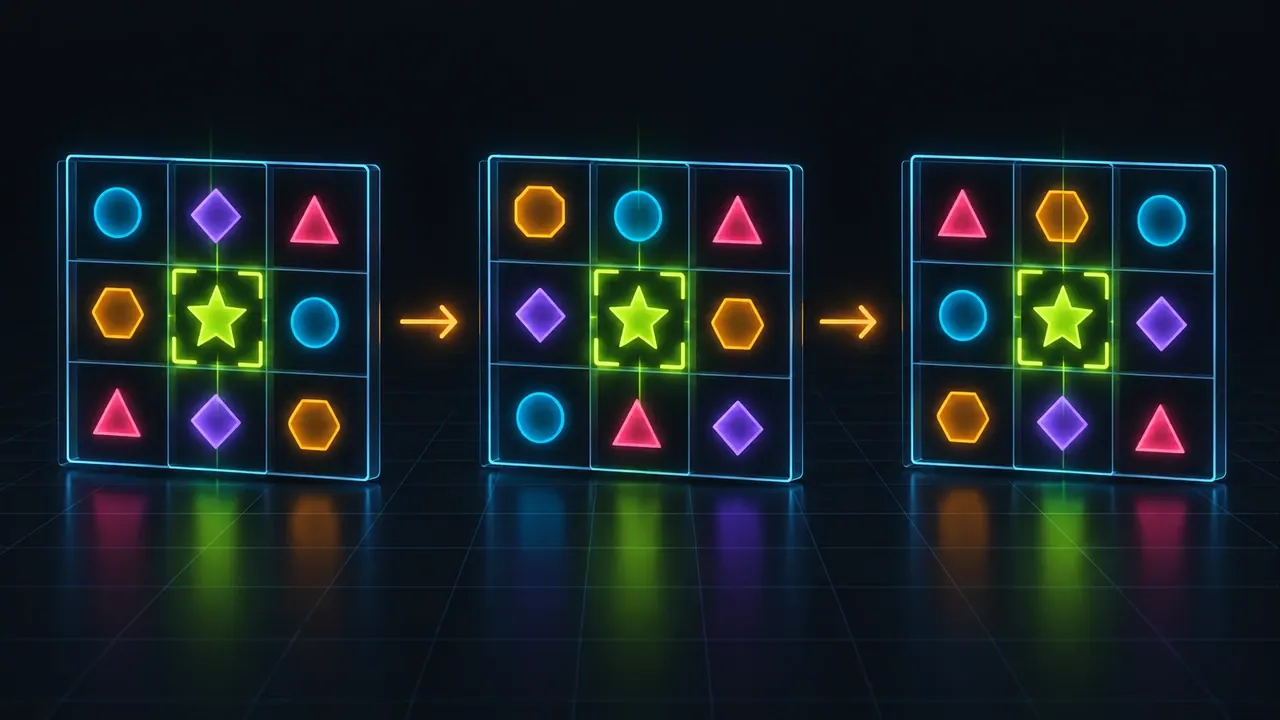
- Grid
- 5 × 3
- Paylines
- 9 fixed
- Engine
- Sticky wilds
- Feature
- Three free-spin modes
The shape of the game
NetEnt's launch material for the 2019 release describes Dead or Alive 2 as a five-reel, three-row game with nine paylines, scatter wins, wild substitution, a sticky wild and three free-spin games. The nine paylines are the detail worth pausing on. By 2019 most studios had moved to ways-based counting or pays-anywhere scoring, where a spin carries far more win combinations than a fixed-line board can. Nine fixed lines is a deliberately old structure, inherited from the 2009 original, with a consequence the artwork does not advertise: narrow win coverage means the base game produces very little.
That is the single most useful thing to know before loading it. On a pays-anywhere game the base spins carry real weight and a session can tick along without a feature. Here the base game is closer to an entry mechanism than a source of return. Judge this title by how the base game feels and you will judge it as broken. It is not broken. It is front-loaded towards a feature you have to reach, and the design only makes sense once you see the base game that way.
Two payout logics also run on the same board, because the provider lists both wild substitution and scatter wins. Wilds stand in for paying symbols along one of the nine lines. Scatter wins are counted without reference to a line at all. Which symbols belong to which logic is in the loaded paytable, worth reading before you conclude an arrangement should have paid. Three matching symbols sitting off the line pay nothing unless the paytable identifies that symbol as a scatter.


18+ · Bonus conditions
Offer information supplied: 2026-10-05.


18+ · Bonus conditions
Offer information supplied: 2026-10-05.
Three free spins, and a choice you only make once
The three modes named at launch are Train Heist, Old Saloon and High Noon Saloon. They are not three bonuses that happen to you at random. They are three configurations of one feature, and you pick one at the start of the round — this game's defining design decision, which handed the volatility dial to the player for the length of a feature.
They differ along three axes: how many free spins the mode awards to begin with, what happens to wins while the round runs — a flat multiple applied to every win, or wilds carrying multiplier values of their own — and the condition under which the round extends itself. Each mode trades one axis against another. A mode that starts with more spins is offering more attempts at a lower per-spin ceiling. A mode where wilds carry multiplier values is offering fewer, heavier attempts. A mode that multiplies every win and extends on a sticky-wild condition rewards a board that fills up over several spins rather than one spectacular arrangement.
Read the mode cards in the loaded game rather than any description of them, this one included. The spin counts, multiplier ranges and extension conditions are printed on the selection screen and in the paytable, and that is the only version of them that governs the build you are in.
A rule that works: decide which mode you want before the feature triggers, not while the selection screen is in front of you. Choosing with the feature already paid for, under a timer, is the exact moment at which people pick whichever card carries the largest number. Choose instead on what kind of round you want. If you want it resolved quickly across a wide range of outcomes, the multiplier-wild card does that. If you want the round decided by accumulation, the extending card does. Neither is better value in any sense the picker lets you establish, because the picker publishes no return figure at all — which is the subject of the next section, and the reason the panel has to be read before the scatters land rather than after.

Sticky wilds on nine lines: why a board can run away
A sticky wild is a wild that stays in the position it landed in instead of clearing on the next spin. The provider lists it as a feature of this game, and it is the mechanism behind the outcomes people record and post. Across consecutive spins in a round, wilds accumulate, and each one locked in place reduces the number of positions still randomising. A spin late in a round is therefore not the same spin as the first one: the round has no constant payout profile, it has one that drifts as the board fills.
Combine that with nine fixed paylines and something counter-intuitive follows. On a game with hundreds of ways, each extra wild adds value smoothly. On nine lines, a wild on a position that several of those lines pass through is worth disproportionately more than one on a position touched by a single line. Which positions the lines run through is in the paytable's payline diagram — the least-read screen in any pokie, and on this title the screen that explains why two rounds holding the same number of wilds paid completely differently.
The failure mode to understand is the extension condition, because it is a condition and not a schedule. Where a mode awards extra spins for sticky wilds landing on reels, the award depends on an arrangement satisfying whatever the rules state — one wild on every reel, a wild on a named reel, or a count reached. A round can end with wilds sitting on the board having never satisfied it. People read "extra spins" on a mode card as "this round will be long", then treat a short round as a malfunction. Read the exact wording: a sticky wild on each reel and a sticky wild on any reel are the difference between a rare extension and a routine one, and both phrasings exist across games in this category.
// sponsored · Safe Casino · 18+
+500% + 120 free spins
Safe Casino welcome offer. Check the qualifying deposit and wagering conditions before you claim.
Why "Dead or Alive 2 RTP" has more than one answer
If you came here for this game's return figure, you were hoping for one number. There are several candidates and only one of them applies to you. NetEnt, now part of Evolution's games division, is among the studios that ship a title in more than one return configuration, and the operator chooses which build to integrate as a commercial decision. Nothing is concealed, since the figure is printed inside the game. But it does mean that a percentage quoted on a review page, including the one attached to this title on affiliate pages since launch, describes a single build in a single lobby on a single day. It might be the flagship build, or a reduced one in the lobby you have open.
This title then adds a second layer most pages never deal with. Because the feature ships as three selectable configurations, there are two questions for the panel rather than one: which configuration this operator integrated, and whether the panel states a single return figure for the game or breaks it out by free-spin mode. A single figure means your mode choice is purely a variance decision, made on temperament. A figure per mode means the picker is also a value decision, taken under a timer, on the one screen in the game that prints no percentage anywhere.
So the order of reading matters here in a way it does not on a single-feature pokie. Read the panel first, from inside the game frame, in the lobby you intend to play in — a demo reached from a search result may be running the studio's own build rather than the one this operator licensed. Then read the paytable's account of the three modes and see whether it repeats what the panel said. If the panel breaks the return out by mode and the cards do not, you have learnt what the picker was never going to tell you, at the only point where it is still useful.
A panel stating no return figure at all is a finding too: a lobby that will not say what it loaded is not one to deposit into on the strength of a figure read elsewhere. If the lobby you will play in is Safe Casino or WinCrown, open this title from there and read its panel on the spot rather than taking any page's word for it, this one included. Which configuration sits behind a tile is a per-integration fact that nothing outside the game frame reports.
Figures differ between builds and lobbies. Read the live game's information panel before you rely on any of them.
Play here →The cap, and what it does to a round in progress
The payout ceiling is the clause on this game most worth reading beforehand, and the sticky wilds are the reason. A game resolving each spin independently reaches a ceiling, if at all, on a single spin. This one can reach it by accumulation across a round, which makes the cap a rule capable of binding while spins are still owed to you rather than a distant theoretical limit.
Three things to establish from the rules. Whether the ceiling is measured per spin, per free-spin round, or per paid round including the base-game spin that bought the feature — on an accumulating board those give very different answers. What the game does at the moment it is reached, because terminating the round and paying out is a visibly different event from letting the remaining spins run with the total frozen. And whether a multiplier applied at the end of a sequence can be truncated by it. Where the mode you selected is putting multiplier values on the wilds that are sticking to the board, that third question decides whether the number you watched build is the number that lands.
If you ever do reach it, the amount showing before the final multiplier was applied and the amount credited will not reconcile, and the explanation sits in the cap clause rather than in a fault. Knowing that clause beforehand is the difference between reading the result as a rule and reading it as theft. The ceiling itself is stated in the game's rules as a multiple of stake; this page does not print it, because it belongs to the build you loaded rather than to the title.
Expressed as a multiple of stake rather than a currency amount, the ceiling does not shrink in relative terms when you play small. It simply becomes an amount irrelevant to you in absolute terms, which is a reasonable thing to accept, and not an argument for raising the stake. On a game that holds its return behind a feature you have to reach, a larger stake mainly reduces the number of attempts you get at reaching it.
Which Dead or Alive you are actually in
There are now several games in this family, and a lobby tile has room for a fraction of a full title. The original Dead or Alive dates from 2009 and is a different game, with a single free-spins route and different maths; it is not an older-looking version of this one. Dead or Alive 2 is the 2019 release described on this page. Further releases have appeared with suffixes, including feature-buy editions, and a suffix is never cosmetic.
The habit worth building is reading the title from the game's own header after it loads, not from the lobby tile. Tiles truncate, in-lobby search matches on partial strings, and a numeral at the end of a shortened name can belong to a release you were not looking for. If you are comparing a figure you noted last month against the panel in front of you now, confirm the titles match character for character before concluding the operator changed the build. Reports of a secretly switched configuration frequently turn out, on that check, to be two different games.
Where a feature-buy edition exists, keep two numbers apart. The purchase price is a multiple of base stake and is charged in full. The purchase also carries its own separately stated return figure, printed in the same panel as the base game's, so if you intend to buy, the base game's figure is not your number. The mode-selection decision still applies on top of the purchase, which means a feature buy on this title involves two choices rather than one, and the second one has a timer on it.
// sponsored · WinCrown · 18+
+500% + 120 free spins
WinCrown welcome offer. Read the current promotion terms, eligibility and withdrawal conditions.
On a phone
Three things change on a narrow screen, and all three hit this title harder than most.
The mode-selection screen is the first. On a phone the three cards become a stack you scroll, and the values that actually distinguish them are set in smaller type than the mode names and the artwork. People pick by name. Scroll each card to the bottom before touching one: the selection is committed for the round and there is no way back to the picker.
The payline diagram is the second. Nine lines drawn across a five-by-three grid are legible in a desktop paytable, and on a phone are usually pushed onto a panel page of their own rather than sitting beside the board. Since the payline layout is what makes a particular wild position valuable here, find it once on your own phone before a session rather than hunting for it mid-round with wilds on the board.
The information panel is the third. Inside a mobile game frame it sits behind a menu rather than on the board, and the operator's own interface can overlay it. If you cannot reach it at all on your phone, that is a reason to run the return and ceiling check on a desktop first. It is not a reason to skip the check.
What this page could not verify
The structural description on this page comes from NetEnt's own launch material for the 2019 release: five reels, three rows, nine paylines, scatter wins, wild substitution, a sticky wild and three named free-spin games. That part is stable across builds and worth writing down once.
Everything numeric is not stable, and this page deliberately prints none of it. Return figures, per-mode spin counts and multiplier ranges, extension conditions and the maximum-win ceiling are properties of the build in front of you. Where a figure quoted elsewhere and the figure in your panel disagree, the panel wins — including against figures repeated unchanged on affiliate pages since launch.
Availability is not asserted here either. Whether a given operator carries this title, which configuration it integrated, and whether a demo is reachable from Australia are per-operator facts that change without notice.
Online casino services cannot lawfully be provided to people in Australia, as ACMA explains, so every operator reachable from here is offshore and answerable to a foreign licensor rather than to an Australian regulator. A familiar studio logo on a lobby tile is a statement about game supply and nothing else. Set a spending and time boundary before opening the game, never gamble with money needed for essentials or with borrowed money, and stop if the purpose has become recovering a loss. Sponsored links on this site can earn the publisher a commission. This page describes a machine; it is not a recommendation to play it.

Questions people actually ask
What is the RTP of Dead or Alive 2?
There is more than one answer, which is why this page prints none of them. NetEnt is among the studios that ship a title in several return configurations, and the operator chooses which build to integrate. The figure that applies to you is in the information panel inside the game frame, in the lobby you intend to play in. Read also whether the panel states one figure for the game or a separate figure per free-spin mode.
Which Dead or Alive 2 free spins mode is best?
None of them is better value in any sense you can establish from the selection screen, because the screen publishes no return figure per mode. They trade starting spins against per-spin ceiling against extension conditions. Decide which kind of round you want before the feature triggers, rather than choosing under the picker's timer with the feature already paid for.
How do sticky wilds work in Dead or Alive 2?
A sticky wild stays in the position it landed in instead of clearing on the next spin, so wilds accumulate across a round and progressively reduce the number of positions still randomising. On nine fixed paylines, a wild on a position several lines pass through is worth disproportionately more than one on a position touched by a single line. The payline diagram in the paytable is what tells you which is which.
Is Dead or Alive 2 high volatility?
The variance or volatility rating is stated in the game's own information panel and that is the figure to read. Structurally, nine fixed paylines give the base game narrow win coverage, which concentrates the designed return in the free spins. A game whose return sits mostly behind a feature you have to reach behaves like a high-variance design regardless of what label a review page attaches to it.
What is the max win on Dead or Alive 2?
The ceiling is stated as a multiple of stake in the game's rules. More useful than the figure is the clause around it: whether it applies per spin, per feature round or per paid round, what the game does when a round reaches it, and whether a multiplier applied at the end of a sequence can be truncated by it. On a game built from accumulating sticky wilds, that last question is not theoretical.
What is the difference between Dead or Alive and Dead or Alive 2?
They are different games, not two versions of one. The original dates from 2009 with a single free-spins route and different maths; Dead or Alive 2 is the 2019 release with three selectable free-spin modes. Further releases exist with suffixes, including feature-buy editions, and a suffix is never cosmetic. Read the title from the game's own header after it loads, because lobby tiles truncate.
// next step
A paytable makes more sense with the game open in front of you.
View current offer