Compare supplier-published returns: Dead or Alive 2 96.80%, Mega Fortune 96.60%, Starburst 96.08% and Gonzo’s Quest 95.97%. These are reference figures, not a guarantee for the version loaded by an operator.
RTP · 4 named options
High RTP pokies: the shortlist
An editorial shortlist ordered by how clearly each game illustrates the category. It is not a league table of winning chances, casino availability or guaranteed returns.
Use rtp in the loaded build as the first filter, then compare volatility and feature return. Read the original title’s rules: a sequel, Megaways edition or feature-buy build may be a different product.
✓ RTP in the loaded build✓ Volatility and feature return✓ Loaded RTP and stake range✓ Demo rules and lawful availability
Sources & comparison basis · reviewed 6 October 2026
Supplier and provider information describes the product, not guaranteed casino availability. Editorial order is not a tested performance score. Promotions remain commercial placements.
18+ only. +500% and 120 free spins are promotional headline offers; eligibility, deposit requirements, wagering, eligible games, maximum bets, expiry and withdrawal limits are set by the operator. Read the complete live terms before accepting. Feature purchases may be excluded or exceed a bonus maximum-bet limit. Availability depends on your location. Offshore operator; no Australian online casino authorisation is claimed. Gambling involves financial risk; a bonus does not guarantee a profit. Offer information supplied: 2026-10-05.
18+ only. +500% and 120 free spins are promotional headline offers; eligibility, deposit requirements, wagering, eligible games, maximum bets, expiry and withdrawal limits are set by the operator. Read the complete live terms before accepting. Feature purchases may be excluded or exceed a bonus maximum-bet limit. Availability depends on your location. Offshore operator; no Australian online casino authorisation is claimed. Gambling involves financial risk; a bonus does not guarantee a profit. Offer information supplied: 2026-10-05.
What the percentage actually promises
A return-to-player figure is a design target computed over an enormous simulated sample — typically tens or hundreds of millions of rounds. At 96%, the game is built so that across that sample it returns ninety-six dollars for every hundred staked.
Three consequences follow, and all three are routinely stated backwards in the material that ranks for this topic.
It is not a session rate
Over four hundred spins the observed return can be anything from zero to a multiple of your stake. The design figure is a limit the maths approaches by volume, which means it is a statement about the game across all players over time rather than about your evening. Nobody experiences 96%; the population of players collectively does.
It is not a schedule
A pokie that has paid nothing for two hundred spins is not closer to paying. Every spin is independent and the game holds no memory of previous rounds. The target is met through sheer volume, not through compensation after a dry run, and any system built on the opposite assumption is built on sand.
It says nothing about how the money arrives
Two games can have identical average return and different payout distributions. Frequent smaller payouts and rarer larger payouts can produce the same theoretical RTP. The averages match; the complete maths and session experience need not.
// sponsored · Safe Casino · 18+
+500% + 120 free spins
Safe Casino welcome offer. Check the qualifying deposit and wagering conditions before you claim.
Volatility describes the distribution of the return rather than its size. It is usually published as a rating from one to five, or as low, medium and high.
Low volatility
Lower volatility generally means less extreme variation, not guaranteed gradual losses or a longer session. The actual result depends on the game, stake and random outcomes. Read volatility alongside RTP rather than treating either as a promise.
High volatility
Higher volatility can involve long gaps between meaningful payouts and rare larger outcomes. Exact feature probabilities are game-specific. A label does not prove that fifty spins will end at zero, so do not read an unmeasured session claim as a probability.
Two games can share theoretical RTP and have different payout distributions. The average return is not the whole game maths. Read the loaded RTP, volatility, stake and feature rules together; no figure decides your individual session.
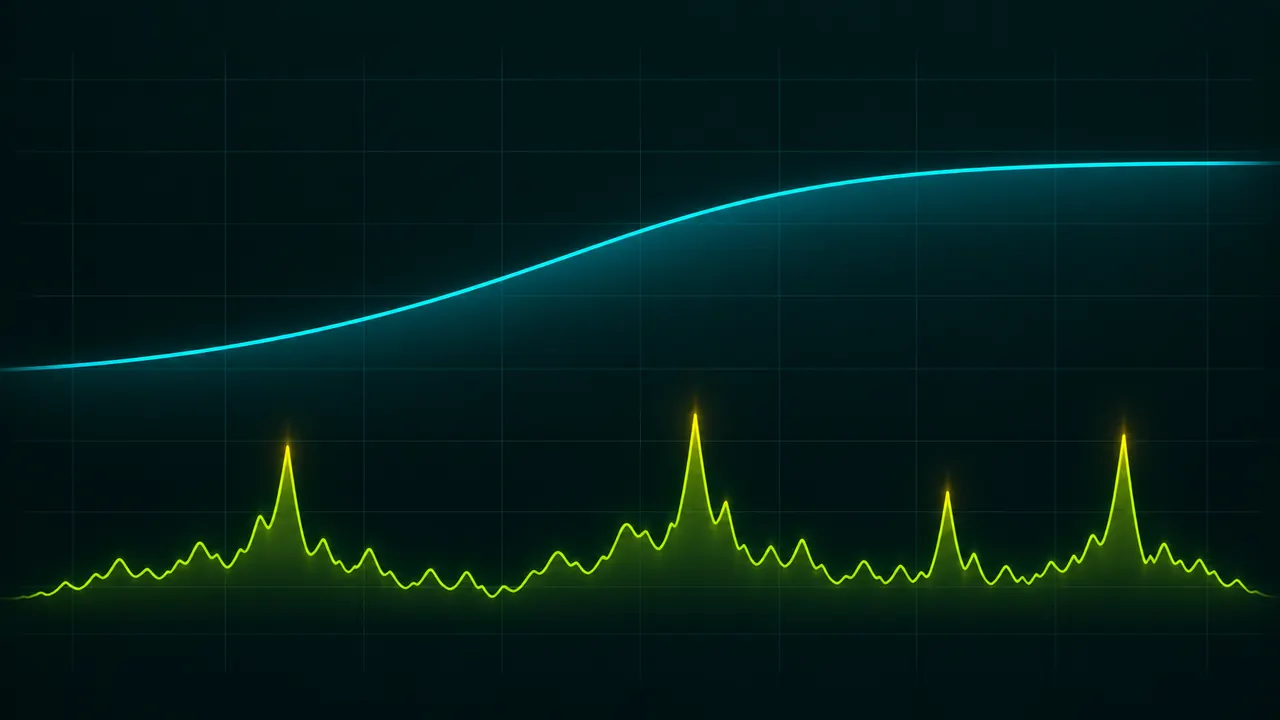
Concept illustration. average return and payout spread are different ideas.
Where the authoritative figure lives
Not on a review page. Not in a studio press release. Inside the game, in the information or help panel — usually a question mark or hamburger icon within the game frame itself. Studios publish it there as a condition of their own certification, and that figure describes the exact build the operator has integrated.
The three-minute check:
Open a well-known title in the lobby, in demo mode if it is available.
Open the game's information panel from inside the game frame.
Find the stated return. It will be there.
Repeat with a second and third title from different studios.
Record these specific titles only. Three checks do not establish which configurations an entire lobby runs.
This takes less time than reading a review of the operator and the answer is specific to the lobby you are about to play in, today, rather than to someone else's lobby last year.
Need a live lobby to run the check in? Open the sponsored operator and come back.
Studios frequently ship one pokie in several return configurations: a flagship build plus one or more reduced builds. The artwork, features and name are identical across them. Which one runs is the operator's commercial decision, made at integration time.
Verify the loaded configuration and any relevant certification claim. A certificate has a defined title, version and scope; it does not prove every game in a lobby runs the highest available return. A quoted percentage should identify its source and configuration rather than implying it applies everywhere.
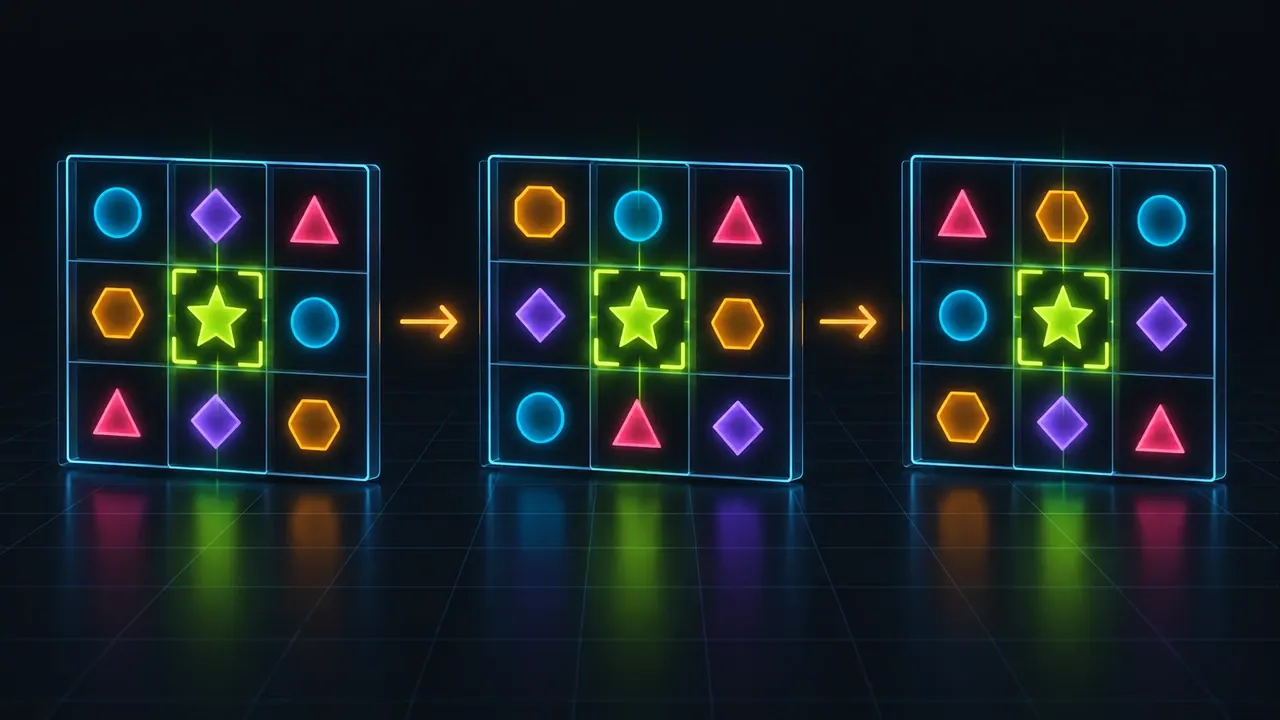
Concept illustration. Certified, identical-looking, different maths. The build is the operator's choice.
What certification does and does not cover
Three different things get described by the same badges, and separating them makes the whole category legible.
What is certified
What it proves
What it does not
RNG testing
The stated generator or product was tested against a specified standard
Does not certify every deployment, payment practice or Australian authorisation
RTP verification
A huge simulated sample matches the declared figure for that build
Applies to one build only; another build of the same title is separately certified
Provably fair
A defined commitment-and-verification procedure can allow checks of round generation
The exact protocol matters; it does not remove house edge or guarantee withdrawals
A certificate that cannot be found on the issuer's own register is a graphic rather than evidence, however convincing it looks in a footer. The registers are public and searchable.
The numbers worth reading instead
If return is a weak signal, these are stronger ones, all published in the same help panel.
Max win. A hard ceiling written into the maths as a multiple of stake. Once a feature reaches it the round ends and pays. On a high-volatility title the entire upper tail compresses into this number, which makes it the most honest description of a best case that exists — and two games with similar volatility can have very different ones.
Hit frequency. The proportion of spins returning anything at all, including returns smaller than the stake. Published less consistently, but it explains why a game feels generous or punishing in a way return never does.
Bonus frequency. On a high-volatility game where most of the return sits in the feature, how often the feature triggers is close to the whole story.
Feature RTP, where a bonus buy exists. Stated separately, and frequently different from the base game.
// exclusive · WinCrown · 18+
+500% + 120 free spins
WinCrown welcome offer. Read the current promotion terms, eligibility and withdrawal conditions.
“Play longer and you converge on the RTP.” Directionally true over millions of spins, irrelevant over an evening. Your session is a tiny sample of a very long distribution.
“Higher stakes get a better return.” Not for pokies. Stake changes the scale of outcomes, not the percentage.
“The casino tightens games when you win.” The operator does not hold that lever per player or per session. The configuration is set once at integration.
“Autoplay pays differently.” It does not. It does make breaching a maximum bet rule much easier to do without noticing.
“A high RTP game is a safe game.” A higher average does not prevent losing a session balance. Volatility, stake and duration also matter.
How the figure is actually produced
Return to player is not measured by watching players. It is computed, and the method explains why the number behaves the way it does.
RTP can be analysed by summing the probability-weighted payouts of possible outcomes, or estimated with a documented simulation. The appropriate method depends on the game. Complex features do not justify assuming a specific studio used one particular method or sample size.
Two consequences worth holding on to. First, the figure is a property of the maths rather than an outcome of play, which is why it is identical in demo mode and real money for the same build. Second, the sample size used to establish it is enormous for a reason: a few hundred thousand spins is not enough for a high-volatility game's average to settle. If a studio needs ten million rounds to see the number, a human session of four hundred spins tells you nothing about it at all — which is the whole argument of this page, arrived at from the other direction.
Returns outside the pokies lobby
Table-game returns depend on the exact rules and selected bet, and sometimes on player decisions. They cannot be ranked against every slot with a generic category figure. Compare a documented game and bet, not a marketing category.
Category
Typical return character
Who controls it
Pokies
Mid-90s for flagship builds, lower for reduced ones
Studio sets the build, operator picks it
Blackjack
Depends on payout, dealer rules and decisions
The exact rules and player choices
Baccarat
High on the main bets, poor on the side bets
The published rules alone
Roulette
Fixed by the wheel — single zero returns more than double zero
The wheel you sit at
Game shows
Different bets and bonus rules can have different returns
The stated table and selected bet
The table games have a property pokies do not: their return is a published consequence of the rules, identical at every operator running those rules, and partly under your control through the decisions you make. A player genuinely optimising for return would leave the pokies lobby entirely. Most people are not optimising for return — they are buying a particular kind of entertainment — and that is a perfectly coherent position, but it is worth holding it knowingly.
Choosing by goal rather than by percentage
The useful question is not “which pokie has the highest RTP” but “what do I want this session to be”. Three honest answers, each with a different specification.
Understanding session risk. Check stake and volatility alongside return. Smaller stakes reduce cash at risk per round, but no game or stake guarantees a session length.
Understanding a large possible prize. Read the maximum-win rule and any published probability. A ceiling is not a likely outcome or a spending target.
Learning a game properly. Demo mode, any volatility, and the help panel open beside it. Costs nothing and teaches more than any review.
RTP, turnover and a worked example
Turnover means total money wagered, not the first deposit. A hypothetical 100 rounds at A$1 generate A$100 turnover even if some returns are reused. The deposit, remaining balance and turnover can therefore be different amounts. This matters when a promotion quotes a wagering requirement: find out whether its multiplier applies to bonus alone, deposit plus bonus or another defined amount.
At a hypothetical theoretical RTP of 96%, the corresponding house edge is 4%. Applying that average to A$100 of qualifying turnover gives A$4 expected loss in the mathematical model. It does not mean a person loses exactly A$4, retains a specific balance or can afford exactly 100 rounds. Individual outcomes can differ substantially, and account restrictions do not disappear because a model has a simple average.
If a second hypothetical configuration has 94% RTP, its modelled edge is 6%, giving A$6 expected loss on the same A$100 turnover. The difference in the two modelled averages is A$2. That comparison does not rank the variance, feature frequency, maximum prize or payment reliability of the games. It also does not establish that either configuration is available at an operator linked here.
Compare like with like
Write down the total charge and selected mode beside each return. A base-game percentage cannot automatically be applied to a purchased feature or a jackpot side stake. If a return includes a progressive component, its meaning differs from a figure excluding that component. When the documentation is unclear, keep the uncertainty rather than averaging incompatible numbers.
A one-percentage-point difference is one unit per hundred units of turnover in the theoretical average, not one extra guaranteed win per hundred spins. There is no rule saying the better-returning game must produce the larger result in a particular short comparison. A small sample cannot validate a advertised percentage, and extending play to “prove” it creates more turnover rather than a reliable personal test.
Read probability wording carefully
A published hit frequency counts qualifying events under its definition. It may include payouts below the charge. Feature frequency describes entry, not how much a feature returns. Maximum win describes an upper limit, not the chance of reaching it. Volatility describes dispersion, but a qualitative label is not a complete probability table. Each answers a different question; none should be silently substituted for another.
Return information is useful for understanding cost, not for recovering past losses. A losing streak does not create a refund entitlement or make the next independent random round owe a prize. Persistent feature state is a separate matter governed by explicit rules. If the purpose of continuing becomes to reach an average or win back money, stop and use the support options linked on this site.
What this page could not verify
No per-title return figures appear here, deliberately, for the reason set out above. We have also not audited any operator's catalogue build by build — doing that credibly would mean opening every title in every lobby and recording the stated figure, then repeating it as integrations change. Where an operator claims it runs flagship builds, this page gives you the test rather than asserting we already ran it.
The certification descriptions are general to how the industry works and are not a statement about any particular operator's current certificates. Those are checkable on the test house's own register, which is where they should be checked.
The table-game comparison describes rule differences, not a measured ranking of every product. A blackjack rule change or side bet can alter return considerably. Compare the documented game and decision assumptions rather than borrowing a headline category percentage.
Nothing on this page should be read as a recommendation to play any game or at any operator. It describes how a published figure is produced, what it governs, and how to find the one that applies to you.
RTP is an average over repeated wagering, not a forecast or refund for your session. Read the rules, keep the stake clear and protect essential money.
Flagship builds from well-known studios commonly sit in the mid-90s, and anything meaningfully above that is unusual enough to be worth verifying in the live game rather than trusting. Reduced builds of the same titles run lower, which is why the category is less stable than it sounds.
Where do I find the RTP of the game I am playing?
Inside the game, in the information or help panel — usually a question mark or hamburger icon within the game frame. Studios publish it there as a condition of their own certification, and that figure describes the exact build the operator integrated.
Does a higher RTP mean I will win more?
Over an enormous number of spins the maths returns more. Over a session it changes very little because variance dominates at that sample size. Choosing a lower-volatility game will affect your evening far more than choosing a half-point higher return.
Why do two casinos show different RTP for the same game?
Some providers offer different configurations. Verify the loaded rules and title-specific source: the name alone does not establish return, authenticity or certification.
Is the max win cap a real limit?
Where a cap is specified, read its scope and how it is enforced. A round, feature or account restriction can apply differently. A large published ceiling is not a likely result.
Does volatility affect the RTP?
No. They are independent. Two games can share an identical return and sit at opposite ends of the volatility scale, which is exactly why reading only the percentage tells you so little about what the game will do.