
- What it is
- A design ratio, not a refund
- Formula
- Each payout times its probability, summed
- Denominator
- Turnover, not your deposit
- Horizon
- A population of rounds, not a session
What the three letters are a ratio of
Return to player is a ratio with a specific numerator and a specific denominator. The numerator is the total amount a game is designed to pay out. The denominator is the total amount wagered into it. Both are counted across the game's full theoretical lifetime, which is an enumerated or simulated population of rounds rather than a record of anyone's play. It is written as a percentage because a ratio slightly below one reads awkwardly.
The figure is a property of the build, in roughly the way a gear ratio is a property of a gearbox. It does not shift with your stake size, the hour you play, the device you play on, or whether you are in demo or real money mode. The same build carries the same figure in both, because the figure lives in the maths model rather than in the session.
Several things it is not. It is not a refund rate; nothing is paid back to you out of a pool. It is not a guarantee, a rate of loss per hour, or a measure of honesty. A game can be certifiably random and perfectly honest at any return figure at all, which is why the percentage and the question of fairness are separate topics with separate evidence. The complement of the ratio, written 1 minus RTP, is the house edge: the share of each wagered unit the design is built to retain on average.
No per-title figures appear on this page, on purpose. A return figure belongs to the build an operator loaded, so the authoritative place to read it is the information panel inside the live game, and the place this site records what it finds is the individual game pages.


18+ · Bonus conditions
Offer information supplied: 2026-10-05.


18+ · Bonus conditions
Offer information supplied: 2026-10-05.
The formula, and a toy game you can compute by hand
The formula is a weighted sum. RTP equals the sum over every outcome of that outcome's probability multiplied by its payout, with the payout expressed as a multiple of the stake. In symbols, RTP is the sum of p multiplied by w across all outcomes i, where p is the probability of outcome i and w is what it pays per unit staked.
Here is a game invented purely for the arithmetic; no real pokie has a paytable this crude. A wheel has ten equally likely segments. One segment pays five times the stake, two segments pay the stake back, and seven pay nothing. The weighted sum is 0.1 multiplied by 5, plus 0.2 multiplied by 1, plus 0.7 multiplied by 0. That is 0.5 plus 0.2 plus 0, so the ratio is 0.7. The house edge is the remaining 0.3, and the expected result of one unit staked is a loss of 0.3 of a unit.
Two details in that calculation are the ones people drop. The losing outcomes are included in the sum, weighted at a payout of zero, which is what makes the denominator the whole of the wagering rather than only the paying part. And the payouts are multiples of the stake, not amounts, which is precisely why the ratio is unchanged when you move the stake up or down.
Real pokies differ from the wheel in scale, not in method. A modern title has an outcome space built from reel strips, ways-to-win rules, compounding multipliers and features whose own internal outcomes have to be enumerated and folded back into the parent sum. Where that space is finite and tractable, the figure is computed in closed form. Where features retrigger, the space is effectively unbounded and the figure is estimated from a very large simulated sample instead. Either way it is calculated before anyone plays.

The denominator is turnover, and that is where the reasoning usually breaks
The denominator counts every unit staked, including units that were won a moment ago and staked again. This is the single most consequential thing about the formula and the least intuitive. A deposit does not pass through a game once. It passes through, comes back partially, goes through again, and the return figure applies to each pass, not to the deposit.
Follow that through with the formula rather than with a feeling. Suppose a fraction R of each wagered unit comes back on average and is immediately re-wagered. The total turnover one deposit generates, in the idealised case of playing until the balance is gone, is the deposit divided by one minus R, because the recycling is a geometric series. The expected loss on that turnover is the edge, one minus R, multiplied by that same quantity. The two factors cancel, and the expected loss equals the deposit.
Read what that model does and does not say. It does not say your deposit is certain to go; it says that in a model where you keep re-staking until you cannot, the return figure governs how many rounds the deposit buys rather than how much of it survives. A higher figure is more playing time per deposit, not a smaller expected loss on the deposit. Variance, and the entirely ordinary decision to stop while a balance remains, are what make real outcomes diverge from that line.
The same arithmetic explains why a turnover requirement attached to a promotion is expensive in a way its headline does not show. Expected cost is the required turnover multiplied by the edge. The multiplier, the base amount it is applied to and the eligible games are therefore all parts of one calculation, and a figure quoted for the game is only one of the three inputs. Which base amount the multiplier applies to is written in the promotion terms, not in the game.
// sponsored · Safe Casino · 18+
+500% + 120 free spins
Safe Casino welcome offer. Check the qualifying deposit and wagering conditions before you claim.
A mean is not a typical outcome
Change the toy wheel without changing its return. Ten equally likely segments again, but now seven pay the stake back and three pay nothing. The weighted sum is 0.7 multiplied by 1, plus 0.3 multiplied by 0, which is 0.7 once more. Identical return figure, completely different game.
Now ask a different question of each wheel. On the first, the middle outcome when you rank them is nothing at all, because seven of ten segments pay zero: the median round loses the full stake while the mean round returns 0.7 of it. On the second, the median round returns the stake. A single number that is 0.7 for both wheels cannot distinguish between them, and it was never built to. The formula compresses an entire distribution into its first moment and discards the shape in the same step.
A real pokie is skewed far harder than either wheel. On a title that keeps most of its designed return inside a feature, the mean is pulled upward by rare outcomes that most rounds never reach, so the gap between the typical round and the average round is wide rather than narrow. A mean sitting well above the median is the mathematical signature of that design.
The dispersion half of this picture is volatility, which has a page of its own on this site and genuinely deserves one. The point that belongs here is narrower and structural: RTP is blind to dispersion by construction, so any argument that treats the percentage as a description of what a session will feel like is reasoning from a quantity that deleted that information at the first step of its own calculation.
Figures differ between builds and lobbies. Read the live game's information panel before you rely on any of them.
Play here →What "long run" means in the formula's own terms
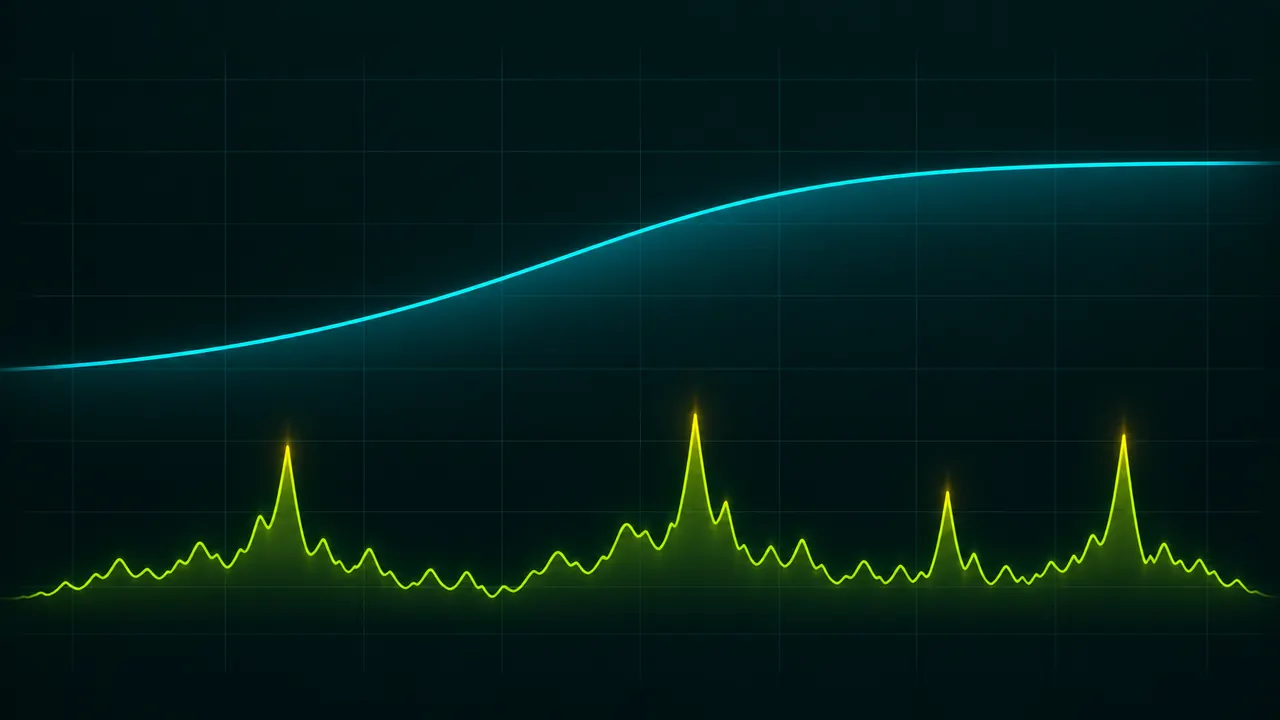
The law of large numbers is the reason the figure means anything: as the number of independent rounds grows, the observed average return converges on the designed one. The useful part is not the convergence, which everyone repeats, but its rate.
The spread of the observed average around the true value shrinks in proportion to the per-round standard deviation divided by the square root of the number of rounds. Two things follow directly. Precision is expensive: cutting the error in half takes four times as many rounds, not twice as many. And the per-round standard deviation is in the numerator, so a game that keeps its return in rare large outcomes needs enormously more rounds to reveal its own figure than a game that pays small amounts often. A studio's verification sample is huge for that reason, and a human's play history is not a small sample of the same thing so much as a different kind of object.
This closes off a specific idea before anyone wastes money on it. You cannot test a quoted percentage by playing, because the number of rounds required to distinguish a plausible figure from a slightly different one is far beyond any session, and the attempt generates turnover, which is exactly the quantity the edge is applied to. If a quoted figure looks wrong, the check is the game's information panel, which costs nothing.
Independence is the other half of the statement and the half that gets quietly dropped. The convergence comes from accumulating independent rounds, not from a game correcting a shortfall. There is no term in the weighted sum for what happened previously, and no mechanism by which there could be. Declared persistent state, such as symbols held between spins, is a feature rule written in the game's own help text and governed by that text, not a debt the maths owes anyone.
When one game carries more than one return figure
A single title can publish several figures, and treating them as interchangeable produces comparisons that look rigorous and mean nothing. An optional higher-stake mode, a side stake, and a feature purchase can each have a theoretical return of its own. The headline figure may be the base game's, a particular mode's, or a blend across modes, and a blend is weighted by an assumed distribution of play, which is an assumption the studio made rather than something it measured.
The blending arithmetic is worth having explicitly. If a share s of turnover goes through one mode at return a and the remaining 1 minus s goes through another at return b, the combined figure is s multiplied by a, plus one minus s multiplied by b. Run that backwards and the problem appears: given only the blend, you cannot recover either component without knowing the other and the weight. A published blended figure therefore does not tell you the return on the specific bet you are about to place.
Two consequences. You cannot average two builds of one title to get "the game's RTP", because each build is a separate maths model and you only ever play one of them. And where a published figure includes a progressive jackpot component, part of that return is realised only by whoever wins the pool, so the portion an ordinary round returns is smaller than the headline. Before comparing such a figure with one from a game that has no jackpot layer, establish whether each is inclusive or exclusive of that component.
All of which makes the reading procedure short: open the game, open its information panel from inside the game frame, and find which figure is stated and what it is stated for. Safe Casino and WinCrown are the two sponsored operators linked from this site, and if you want a live lobby to practise that reading in, open one and check the panel there rather than trusting a percentage written on a page like this one. What the panel says about the build in front of you outranks anything a guide asserts.
// sponsored · WinCrown · 18+
+500% + 120 free spins
WinCrown welcome offer. Read the current promotion terms, eligibility and withdrawal conditions.
Seven ways the number gets misused
A game is "due" after a drought. This is the formula read as a promise of convergence within a window, which is not what it says. Rounds are independent and the sum contains no history term, so a long losing run changes nothing about the next round's distribution. The percentage is treated as a refund. It is not money set aside for you. It is a ratio describing a design across a population of rounds, and no individual round or session is entitled to it.
The edge is treated as a budget. One minus the return figure, applied to an amount, gives a modelled expected loss on that amount of turnover. It does not forecast a session result, promise a balance after a given number of rounds, or set a floor under anything. Stake size is thought to move the return. The payouts in the weighted sum are multiples of the stake, so scaling the stake scales the amounts and leaves the ratio alone. What stake actually changes is how fast the variance you already had is expressed in dollars.
Hit frequency is substituted for return. Hit frequency counts rounds that pay anything at all under its own definition, including amounts smaller than the stake. Two games with the same return can differ wildly on it. Two figures for one title are averaged. Builds are separate models. The average of two models you are not playing describes nothing.
A base-game figure is applied to a different bet. A side stake, a purchased feature or a jackpot-qualifying wager is a different wager with its own maths, and the base figure does not transfer to it.
What the number is genuinely useful for
Three uses survive everything above, and they are narrow enough to state precisely. First, comparing two builds of the same title, where the artwork, features and distribution shape are the same and the return figure is the only thing moving: that is the one comparison where the percentage is close to a complete answer. Second, costing turnover in model terms, which is how a wagering requirement or a long-session budget is reasoned about rather than guessed at. Third, sanity-checking a figure you were told against the figure in the live panel, which is a check on the source rather than on the game.
Notice what all three have in common. Each uses the ratio as a cost input, and none uses it as a prediction. The formula produces an average over a population of rounds; it was never asked to describe one person's evening, and it cannot be made to by rephrasing the question.
Nothing here is a method for winning, and no arrangement of these numbers becomes one. The edge is in the weighted sum by design, it applies to turnover, and more turnover is the only thing additional play reliably produces. Online casino services cannot lawfully be provided to people in Australia; operators discussed anywhere on this site are offshore, and reaching a website is not evidence of Australian authorisation. Set a spending and time limit before you open a lobby, never stake money needed for essentials, and stop if the reason for continuing has become recovering a loss or reaching an average.
This page verified no operator's catalogue and quotes no title's return figure, because a figure quoted here would describe a build in someone else's lobby on some earlier day. The formula is stable and portable; the numbers you feed it are not, and they are read in the panel in front of you.

Questions people actually ask
What is RTP in pokies?
It is a ratio: the total amount a game is designed to pay out divided by the total amount wagered into it, counted across an enumerated or simulated population of rounds. Written as a percentage. It is a property of the build's maths, not a record of anyone's play, and it is identical in demo and real money for the same build.
How is RTP calculated?
As a weighted sum. Multiply each possible outcome's payout, expressed as a multiple of the stake, by the probability of that outcome, then add every term together including the zero-paying ones. Where the outcome space is finite it is computed in closed form; where features retrigger it is estimated from a very large simulated sample.
Does a quoted return figure mean I keep that share of my deposit?
No, and this is the most common error. The denominator is turnover, not deposit, and winnings that are re-staked count again. In a model where you keep re-staking until the balance is gone, the expected loss equals the deposit regardless of the figure. A higher return buys more rounds per deposit, not a larger surviving balance.
Can RTP predict what my session will do?
No, structurally. The formula compresses an entire payout distribution into its average and discards the shape in the same step, so two games with identical figures can have completely different typical outcomes. Dispersion is volatility, which is a separate measure on a separate page.
Can I check a game's RTP by playing it?
No. The error around an observed average shrinks only with the square root of the number of rounds, multiplied by the per-round standard deviation, so distinguishing one plausible figure from a nearby one takes far more rounds than any session. Read the figure in the game's information panel instead; playing to test it only generates turnover.
Why does one game show several different RTP figures?
Because an optional mode, a side stake or a feature purchase can each carry its own theoretical return, and a headline number may be a blend weighted by an assumed distribution of play. A blend cannot be unpicked into its components, and a figure that includes a progressive jackpot component overstates what an ordinary round returns.
// next step
A paytable makes more sense with the game open in front of you.
View current offer