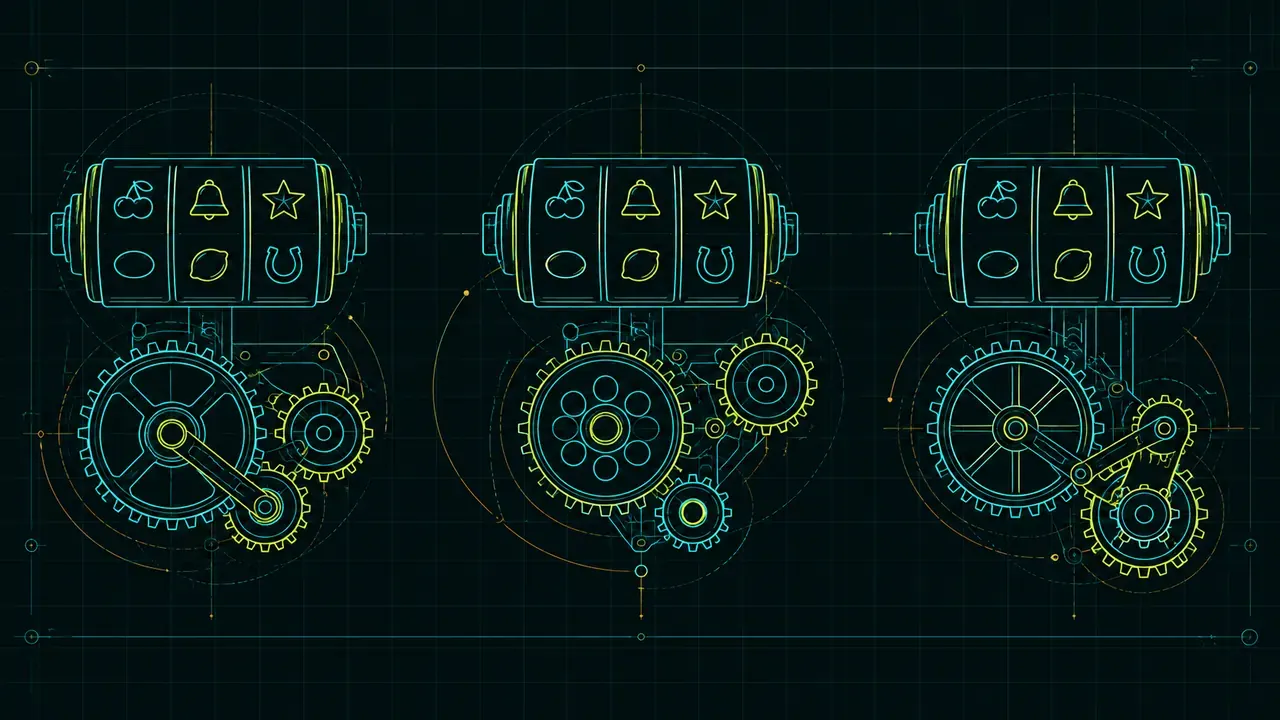
Understand pokies before making a choice: how wins form, what RTP and volatility mean, how features work and where to check the loaded game rules. A bigger maximum prize is not a better chance of winning, and no game promises a profitable session.
18+ only. +500% and 120 free spins are promotional headline offers; eligibility, deposit requirements, wagering, eligible games, maximum bets, expiry and withdrawal limits are set by the operator. Read the complete live terms before accepting. Feature purchases may be excluded or exceed a bonus maximum-bet limit. Availability depends on your location. Offshore operator; no Australian online casino authorisation is claimed. Gambling involves financial risk; a bonus does not guarantee a profit. Offer information supplied: 2026-10-05.
18+ only. +500% and 120 free spins are promotional headline offers; eligibility, deposit requirements, wagering, eligible games, maximum bets, expiry and withdrawal limits are set by the operator. Read the complete live terms before accepting. Feature purchases may be excluded or exceed a bonus maximum-bet limit. Availability depends on your location. Offshore operator; no Australian online casino authorisation is claimed. Gambling involves financial risk; a bonus does not guarantee a profit. Offer information supplied: 2026-10-05.
The four numbers that describe any pokie
Start with four concepts: return to player, volatility, hit frequency and maximum win. Not every game publishes all four, and they do not describe it completely. Together with the payout table and feature rules, they help you read what is actually on offer.
RTP
Long-run return
Volatility
How it is paid out
Hit frequency
How often anything lands
Max win
The hard ceiling
Return to player
The share of total money wagered that the game is designed to pay back across an enormous number of spins. A 96% pokie is built to return ninety-six dollars of every hundred staked over that theoretical lifetime. It is a design target approached by volume, not a refund rate, and it tells you nothing useful about four hundred spins on a Thursday night.
Volatility
Volatility describes the spread of payouts around the average. A low-volatility game tends to have less extreme variation, but either type can lose money quickly. A label does not predict your session, and different providers use different scales.
Hit frequency
The proportion of spins that return anything at all — including returns smaller than the stake. A game can have a 25% hit frequency and still feel relentless, because a win of less than your bet is a loss with a sound effect.
Max win
Read whether the rules specify a maximum payout per spin, feature or round, and whether it is a stake multiple or currency amount. The cap is a limit, not an estimate of a likely prize. Check what happens when it is reached; termination and remaining-spin rules differ.
What a spin actually is, underneath the animation
A spin is a lookup rather than a race. When the stake is committed, a random number generator produces values, the game maps those values onto positions on its reel strips, and the entire result for that round exists before a symbol has moved on screen. The spinning, the late stop on the third reel and the pause before a scatter lands are a replay of a decision already taken. Nothing done between pressing the button and the reels settling can reach the outcome, because by then there is nothing left to reach.
The reel strip is where a designer actually controls a game. A strip is an ordered list of symbols and each reel has its own; the visible window shows a few consecutive entries from it. A symbol that turns up rarely is written onto the strip fewer times, or placed on only some of the reels, which is why a premium symbol can stay absent for hours with nothing unusual having happened. Two games with the same grid and the same payout table can behave entirely differently because their strips are composed differently.
Weighting adds a second layer. A game may draw from one set of strips in the base game and a different set during a feature, which is how free spins produce results the base game structurally cannot. Where a certification statement exists, what a test house examined is this machinery — that the generator is unpredictable and that the implemented mathematics matches what was submitted. It does not examine which configuration an operator later chose to switch on. The RNG and certification guide covers that scope question properly.
Two consequences are practical. A stop button, a quick-spin toggle or a turbo mode shortens the presentation and changes nothing about the result, so a faster setting only raises how many rounds an hour costs you. And the sequence carries no memory: a round does not become likelier to pay because the last twenty did not, and visible state such as a locked symbol or a running multiplier persists because that game's rules say so, not because anything is owed.
// sponsored · Safe Casino · 18+
+500% + 120 free spins
Safe Casino welcome offer. Check the qualifying deposit and wagering conditions before you claim.
This is the fact that makes most pokie writing unreliable, and it is not widely known outside the industry. A studio frequently ships a single title in several return configurations — a flagship build plus one or more reduced ones. The artwork is identical. The features are identical. The name is identical. The maths is not.
Which build runs is the operator's commercial choice, made at integration time. Two casinos can therefore offer what looks like the same pokie at materially different returns, and both are telling the truth when they call it by its name.
The practical consequence: a return figure quoted on any review site — including this one — is a snapshot of one build in one lobby on one day. The only authoritative number is the one inside the live game's help panel, in the lobby you are playing in, today. That is why this site teaches you to read it rather than publishing a table of percentages that would be wrong by next month.
Concept illustration. Same artwork, same features, different maths. The operator picks which one you play.
Want a live lobby to run the help-screen check in? The sponsored operator is one click away.
Before any of the named mechanics, a pokie has to decide what counts as a win at all, and commercial design uses only a handful of answers. A payline game evaluates fixed paths across the grid and pays a combination only where it sits on an active line, so three matching symbols on screen can pay on one game and pay nothing on another. A ways game drops the paths and asks a simpler question: does each reel, starting from the leftmost, contain at least one matching symbol? Height within a reel stops mattering, and the number of combinations evaluated becomes the product of the visible symbol positions on each reel.
Cluster games abandon the reel as a unit entirely. A win is a group of matching symbols meeting a minimum size, normally required to touch orthogonally, and the grid is assessed as a field rather than as columns. The variable-height formats licensed under the Megaways name are a ways game with one addition: each reel shows a different number of positions on each spin within a stated range, so the ways count is recalculated every round. That is why the headline figure such a game advertises is the product of every reel simultaneously at its tallest — the ceiling of the arithmetic, not a description of a typical spin.
Knowing which family you are in changes which part of the rules matters. On a payline game, read the line count and whether lines pay in both directions. On a ways game, read whether your stake activates every reel, because some designs sell reels rather than lines and a deactivated reel makes the top rows of the payout table arithmetically unreachable. On a cluster game, read the minimum size and the adjacency rule, since whether diagonal contact counts is the difference between a frequent win and nothing at all.
Win model
Unit evaluated
What forms a win
The rule readers miss
Fixed paylines
Defined paths across the grid
Matching symbols sitting on an active line
Whether lines pay left to right only, and whether all are active
Ways / all-ways
Reels, left to right
One or more matching symbols on each consecutive reel
Whether the stake you chose activates every reel
Variable-height ways
Reels with a changing number of positions
The same reel rule, with the ways count recalculated per spin
The advertised ways figure is the maximum, not the average
Cluster pays
The whole grid as a field
A group of matching symbols meeting a minimum size
Whether adjacency includes diagonals
Scatter pays
Symbol count anywhere on screen
A qualifying number of symbols regardless of position
Whether an award is paid on top of entering the feature
The mechanics worth understanding
Most modern pokies are assembled from a small set of mechanics that recur across studios. Learn the six below and almost any new release becomes legible on sight.
Mechanic
What it does
What to check
Megaways
Variable reel heights change the ways count
Reel range, matching rule and title volatility
Hold & spin
Collected symbols can lock while a respin counter resets
Required symbols, counter and prize rules
Cluster pays
Wins form from qualifying symbol groups
Adjacency and minimum cluster size
Tumbling reels
Winning symbols clear and are replaced
Sequence timing, multipliers and resets
Bonus buy
A stated charge can enter a feature
Total price, mode return and promotion exclusions
Jackpot link
A separate prize layer connects qualifying games
Funding, eligibility, trigger and payment rules
The Megaways misunderstanding
“117,649 ways to win” is the maximum, not the norm. It occurs only when every reel displays its tallest configuration simultaneously, which is uncommon by design. A typical spin offers a small fraction of that, and the headline figure is a licensing brand rather than a description of the game you are playing.
The jackpot trade-off
Some progressive jackpots receive a contribution from qualifying stakes. Where total RTP includes a jackpot component, distinguish it from ordinary payouts. It does not follow that every jackpot game has a lower total return than every non-jackpot game. Use its own funding, eligibility and payout rules.
Concept illustration. Reel heights vary per spin. The advertised maximum is the ceiling, not the average.
// exclusive · WinCrown · 18+
+500% + 120 free spins
WinCrown welcome offer. Read the current promotion terms, eligibility and withdrawal conditions.
Volatility, hit frequency and the shape of a session
Return to player describes the destination; volatility describes the road. Two games built to the same return can produce completely different evenings, because the figure states how much is designed to come back in total and says nothing about whether it arrives in small regular amounts or in one rare event. This is why choosing on return alone is a category error: a percentage point of return is a rounding difference next to the effect of moving from a low-volatility design to a high-volatility one.
Hit frequency and volatility are routinely confused and they measure different things. Hit frequency counts how often a round returns anything at all, including returns smaller than the stake; volatility describes how far the paying rounds spread from the average. A game can pay on a large share of rounds and still take a balance down steadily, because most of those payments are fractions of the stake — the screen celebrates and the number falls. Read them together, because frequent small returns funding a rare large feature is a different proposition from occasional returns of moderate size.
On a high-volatility design the base game is deliberately thin. Most of the intended return has been moved into the feature, so ordinary spins are funding an event engineered to be uncommon, and the long stretches between features are the mechanism rather than a fault. The honest way to read that is as a statement about how the money is likely to leave rather than about how it might arrive: a design that holds its return in a rare event will, for most of any session, simply be taking the stake. No amount of play entitles you to the event, and a longer session is more money staked rather than a better position.
No band predicts a session. The table below describes how designers distribute a fixed intended return, and studios use different scales and different words for the same thing, so a rating from one provider is not comparable with a rating from another. Treat the label as a statement about design intent, then read the feature rules to see where that intent actually sits. The volatility guide takes the distinction further.
Volatility band
Where the return is placed
What a session tends to look like
What to read first
Low
Mostly in the base game, in small amounts
Shallow movement in both directions; the balance curve has few steps in it
The base-game payout table, because that is where the return lives
Medium
Split between base game and a feature that triggers more readily
Visible swings, with features arriving often enough to form part of the rhythm
The trigger condition and what an ordinary feature contains
High
Concentrated in a feature engineered to be uncommon
Flat stretches punctuated by one round that decides the result
The feature rules, the multiplier structure and the win ceiling
Extreme
Almost entirely in the upper tail of the feature
Flat stretches long enough that the designed event should not be assumed reachable
The cap, and whether the advertised maximum applies to your build
Pokies, not slots — and what Australians actually find online
Australians search for pokies; the rest of the English-speaking internet searches for slots. That is partly vocabulary and partly expectation. Decades of pub and club gaming shaped what an Australian expects a machine to feel like, and those expectations do not survive contact with an offshore lobby unchanged.
The most common disappointment is the catalogue. The venue classics — the Aristocrat cabinets people actually grew up with — have a limited and inconsistent online presence. Where a venue-famous name does appear online, it is frequently a differently engineered build that shares artwork and a title and very little mathematics. The online catalogue is instead dominated by the international studios: Pragmatic Play, Play'n GO, Nolimit City, Hacksaw, Push Gaming, Relax, NetEnt and the Big Time Gaming licensees.
Land-based machines operate under state or territory rules. A foreign online licence does not create Australian authorisation. If certification is claimed, identify the issuer, title and scope. Do not assume every reachable game is genuine or certified because a badge appears in a footer.
Aspect
Venue pokies
Offshore online lobby
Return
Within a state-regulated band
Set per build by the studio; several builds per title
Certified by
State regulator + accredited test house
Test house contracted by the studio
Max win
Machine and jackpot design
Hard cap in the maths, as a multiple of stake
If something is wrong
Venue, then the state regulator
Operator, then its offshore licensor
Concept illustration. A familiar game name does not carry the venue's regulatory protections into an online lobby.
Demo play and what it cannot show you
Free play can help you recognise the controls and feature sequence without staking cash. Check whether its title, mode and configuration match the game you want to understand. Do not assume an independently hosted demo establishes a particular operator’s real-money rules.
Three things it cannot show you. It cannot show you which configuration an operator runs, because the demo you find through a search engine may be the studio's flagship build while the lobby runs a reduced one. It cannot show you how the game behaves with money attached, which is a fact about you rather than about the game. And it is not always available: some operators gate demos behind registration, and availability varies by jurisdiction in ways the studio does not control.
Reading about a feature is slower than seeing it. Open a lobby and come back.
Features vary in theme far more than in structure, and nearly all of them are one of four shapes. Free spins award a number of rounds at no further stake, and what separates one free-spin round from another is what persists between spins: a multiplier that increments and does not reset, a wild that stays where it landed, an expanding symbol drawn at the start. Read whether the round can retrigger and on what condition, because a retrigger is worth considerably more to a long feature than to a short high-multiplier one.
Hold-and-spin rounds work the other way round. The grid is cleared, collected symbols lock in place carrying a stated value, and a respin counter decrements on every spin that locks nothing and resets when something new locks. The round ends when the counter runs out or the grid fills, and the rules rather than the animation state which values are in play, whether a locked symbol can upgrade, and what filling the grid awards. Pick rounds hand the player a screen of choices that reveal a prize or a modifier; where the reveals are predetermined the order of selection cannot change the result, and the rules will say whether a particular reveal ends the round.
Cascading or tumbling rounds resolve as a sequence instead of one stop. Winning symbols are removed, replacements fall in, and each new win pays again until a board produces nothing. What decides the value of the round is multiplier timing: whether the multiplier increments on each successive board, whether it resets between rounds, and whether it applies to the board that triggered it or only to boards after it. Those three clauses produce very different totals from an identical visible sequence, which is why a round-history entry explains an amount better than the final arrangement on screen.
Bonus buy and ante bet: paying to skip the waiting
A feature purchase converts a long, cheap sequence into a short, expensive one. The charge is normally expressed as a multiple of the base stake and is paid per entry, so the arithmetic to do first is simple: multiply the price by the number of entries you would realistically make, then compare that with the total you set aside for the whole session. A purchase priced at a hundred base stakes spends a session's worth of ordinary rounds in a few minutes, and the spread of the result is concentrated into them.
The purchased mode usually carries its own stated return, separate from the base game's, printed in the rules rather than on the button. It can sit above or below the base figure depending on the title and the build, so a purchase is not inherently good or poor value — it is a different product inside the same game, and the only way to know which direction it moves is to read the mode's own figure in the live help panel. Nothing about buying a feature alters the designed return of either mode; it alters how quickly you arrive at it.
An ante bet is the milder version of the same trade. Where a game offers one, it adds a stated percentage to every spin in exchange for a changed trigger condition, and the rules normally state a separate return for the raised-stake mode as well. Both controls share two traps worth checking before use. The confirmation amount is the real charge and may not match the figure shown on the base stake display. And a promotion's terms frequently exclude feature purchases outright or treat them as a maximum-stake breach, which is an account condition rather than a game rule and has to be read separately. The bonus buy guide lists what to find in the rules first.
Jackpot structures, and the ceiling above everything
A jackpot is a separate prize layer attached to a game, and its structure decides almost everything about it. A stand-alone jackpot sits inside one game, is funded only by play on that game, and resets to a stated seed when it pays. A linked progressive pools a contribution from qualifying stakes across many games and often many operators, which is why the displayed figure can move while you are not playing and why its trigger is frequently independent of the base game's symbols. A must-drop or time-limited pool adds a guarantee that it will pay before a stated amount or deadline, which narrows when it can pay without making any individual round more likely to be the one that does.
Where the money for it comes from
The contribution comes out of the stake, which means the jackpot layer and the ordinary payouts are drawing on one pool. For a single player the consequence is specific: the slice of return carried by a rare pooled prize is, in practical terms, not coming back, so a game's base-game experience is thinner than its headline figure suggests by exactly that slice. Then read eligibility, which is where the expensive mistakes live. Some designs require a minimum stake to qualify, or qualify only certain bet types or certain modes, and staking below that line means contributing to a prize you cannot be awarded.
How the layer is entered is the other half of the structure, and there are three common arrangements. A random trigger can award the pool on any qualifying spin with no symbol condition at all, which is why such a game's paytable appears to say nothing about it. A collection mechanic requires specific symbols to accumulate, sometimes persisting across sessions and sometimes reset by leaving the game. A wheel or pick stage awards one of several tiers, in which case the headline figure belongs to the top tier only and the lower tiers are what the stage usually resolves to. Keep a jackpot win separate from a feature win in your reading: different sections of the rules govern them, and a game can pay a large feature without touching the pool at all. The jackpot types guide separates the structures in full.
Why the cap matters most on the loudest games
A maximum win is a hard truncation written into the maths, usually as a multiple of the stake. Its importance scales with volatility. On a low-volatility design the ceiling sits so far above anything the game ordinarily produces that it is decoration; on a high-volatility design the cap is part of the intended distribution and the feature is built to approach it. That inverts the usual reading of an advertised maximum: a very large number beside a high-volatility title tells you the designer concentrated the return into a tail, not that a large prize is within reach.
The cap also interacts with the mechanics above it in ways the screen does not explain. On a design with an uncapped multiplier the ceiling is what makes the multiplier finite in practice, so two builds with the same multiplier structure and different caps are not the same game. Where a jackpot layer sits on top, read whether the pool is counted inside the cap or outside it, because the answer decides whether a jackpot award can be truncated. And the cap is a per-build figure like the return is: a maximum quoted for a title in one lobby is not evidence of the maximum in another. The max win guide works through the clauses to check in the rules.
How to use this site
Choose a guide by your question. If RTP figures disagree, start with the return guide. If the ways count changes, read Megaways. If a button costs many times the base stake, read the feature-buy guide before using it. These guides compare mechanics; sponsored casino cards are not independent game rankings.
Every game page follows the same shape, because the same questions decide whether a pokie suits you. Knowing the shape means you can skip to the part you need.
The shape of the game. Grid, win type, engine, feature. Four lines that tell you what kind of machine it is before any numbers appear.
The feature, in detail. On a high-volatility title this is where the designed return lives, so it gets the most space. How it triggers, what happens inside it, whether anything persists between spins, and whether it can retrigger.
Ways in. Ordinary spins, optional higher-stake mode or feature purchase. Check the complete charge, any mode-specific return and whether a promotion excludes it.
Variants. Where a title ships in more than one version, what actually differs. Usually the multiplier range, the frequency and the cap, all three moving together.
Which numbers to read and where. Never a table of figures — a pointer to the live help panel and a list of the five values worth finding there.
Session risk. Examples explain how costs and payouts work without pretending we measured a likely session outcome.
What the page could not verify. Stated plainly at the end of every page, so you know where the writing stops and guessing would start.
Keep account conditions separate from game rules. A feature can exist in a game and be excluded by a casino promotion. Check the qualifying deposit, eligible games, maximum stake, wagering contribution, expiry and withdrawal restrictions. A “+500%” headline does not show all those conditions; 120 free spins normally apply to specified games, not every title in a lobby.
Read a round, not just the win animation
A stake, a payout and a profit are three different amounts. If a round costs A$1 and returns A$0.40, its net result is a loss of A$0.60 even when the game calls it a win. If the next A$1 round returns A$3, its net result is A$2. Across those two rounds, A$2 was staked and A$3.40 returned: the combined net result is A$1.40. This is an arithmetic example, not an expected sequence.
Tumbles can make the screen harder to read. The first board may pay and clear, then another board may pay before a non-paying board ends the sequence. The round total includes earlier winning boards that are no longer visible. A round-history entry is more useful than the final arrangement if you want to understand how an amount was calculated. Check the game’s multiplier timing before attempting to reconstruct it.
Separate the controls
The displayed base stake may not be the final charge. An optional mode can add a percentage, a side stake can add a separate amount and a feature button can cost many base stakes. Read the confirmation amount in the account currency. A multiplier on a prize and a multiplier on the purchase price are not the same thing. Neither a green button nor an animation explains which one is being applied.
For illustration, A$0.50 ordinary spins, a mode priced at 125% of that stake and a purchase priced at 100 times that stake would cost A$0.50, A$0.625 and A$50 respectively before any game-specific rounding. The interface should show the actual payable amount. These hypothetical prices do not describe the sponsored operators or promise that their catalogues contain a particular mode.
Make a short comparison note
If comparing two versions, record the exact title, provider, date, mode, loaded return where stated, total charge and payout limit. Add how a feature starts and whether an extra stake is required. That is more informative than comparing two screenshots labelled “high RTP”. Leave a field unknown when its source does not answer it; filling a gap with a familiar number from another title makes the comparison worse.
A game rule describes the game. Account terms describe deposits, verification, promotions and withdrawals. Keep these notes separate. A correct payout table does not prove an operator pays withdrawals reliably, and a familiar payment logo does not establish Australian authorisation. If controls or conditions are unclear, stop and seek clarification instead of placing a test deposit.
Reading the information panel before you stake
Every build carries its own rules inside the game frame, reachable from a menu, an information icon or a paytable button, and that document overrides anything written about the title anywhere else, including here. Open it before the first paid round rather than after a result you did not follow. Six things are worth copying out: the stated return and whether more than one figure is given, the volatility rating, the maximum win and the unit it is expressed in, the full title string from the game's own header including any suffix, the feature trigger condition, and the price of every optional mode or purchase.
The payout table needs reading in the right order. Symbol values are almost always quoted per line or per way at a stated reference stake rather than in your account currency, so a figure there is a multiplier you still have to apply. Check which symbols the wild substitutes for and whether it covers the scatter, because a wild that cannot complete a trigger is the commonest source of an apparently wrong result. Then read the feature section for what persists between spins, and finally the exclusions, which is where a game states that one win type does not combine with a particular multiplier.
Panels hide things structurally rather than deliberately, and knowing where helps. Many builds split the document into separate tabs or screens — a paytable, a rules page and sometimes a separate feature page — so a figure absent from the first screen is frequently three swipes away rather than missing. Long panels scroll inside their own frame, which on a phone can look like the end of the document when it is the end of the visible box. And where a panel falls back to the studio's default language for part of its text, that fallback section is the original wording and is worth more than a translated summary of it.
The same title, two lobbies, different behaviour
Return configuration is the best-known reason a title differs between operators, but it is not the only one. Builds are versioned, so one lobby can be running a release that includes a mechanic, a mode or a symbol change the other does not. Stake ranges, minimum and maximum, are set per integration, which can put a jackpot's qualifying stake or a feature's price out of reach in one lobby and not in another. Feature purchases and ante bets are switched off wholesale in some markets, demo builds are gated the same way, and the autoplay and loss-limit controls a game ships with can be removed or restricted by the lobby wrapper rather than by the studio.
Checks before depositing
Check whether the service is lawful where you are. ACMA explains that online casino services cannot lawfully be provided to people in Australia. Being reachable, displaying Australian dollars or showing familiar provider artwork is not proof of authorisation. Offshore services may lack Australian consumer protection; an attractive bonus does not change that.
Inspect the promotion conditions, not only its headline. Is wagering on bonus alone or deposit plus bonus? Are spins released immediately or in stages? Which games count and before what deadline? A cashout cap or excluded feature purchase can change an offer materially. If the rules do not answer a question, do not fill the gap with an assumption.
Set a spending and time boundary beforehand. Never use money needed for essentials or borrow to gamble. Stop if the purpose becomes to recover losses or finish wagering at any cost. Sponsored links can earn this publisher a commission. Operator stars and review counts are promotional figures supplied by partners through the owner, not scores from our own tests. Read the commercial-information page for their source.
Flagship builds from well-known studios commonly sit in the mid-90s and reduced builds of the same titles run lower. But a percentage point of return changes your evening far less than the volatility rating does, so read both and weight volatility higher when you are choosing what to play.
Can a casino change a game's RTP?
Not within a build, but it chooses which build to run. Studios frequently ship one title at several return configurations and the operator selects one at integration. That is why the authoritative figure is the one in the live game help panel rather than one quoted on a review page.
How can I check whether a game is genuine?
Check the provider’s release information, loaded rules and any certificate’s issuer and scope. This site has not independently verified every sponsored operator. Being able to reach a website does not prove Australian authorisation.
Does a pokie become due after losses?
An independent random round does not owe a compensating win. Visible feature state, such as held symbols or multipliers, follows that game’s rules, not a debt owed to the player.
Is a bonus buy better value than spinning for the feature?
It is faster, not better. The buy usually carries its own stated RTP which may be slightly above or below the base game, and it sharply increases variance by compressing a long session into a few expensive rounds. On bonus funds it is also a common way to breach a maximum bet rule.
Why can I not find the Aristocrat pokies I know from the pub?
Their online presence is limited and inconsistent. Where a venue-famous title does appear online it is often a separately engineered build sharing artwork and a name but not the machine mathematics you remember.
Does demo play use the same maths as real money?
A demo is useful for controls and feature behaviour. Confirm the same title, mode and configuration before comparing it with real-money play; a demo elsewhere does not verify an operator’s loaded build.
Does pressing stop, or using turbo, change the result?
No. The outcome is determined when the stake is committed and the animation is a replay of it, so a stop button or a quick-spin setting only shortens the presentation. The one real effect is on cost: a faster setting means more rounds, and therefore more money staked, per hour.
Is volatility the same thing as hit frequency?
No, and they can move in opposite directions. Hit frequency is how often a round returns anything at all, including returns smaller than your stake; volatility is how far the paying rounds spread from the average. A game can return something on most rounds and still reduce a balance steadily, because most of those returns are a fraction of what the round cost.
Does a progressive jackpot lower the base game’s return?
The jackpot contribution comes out of the stake, so where a stated total return includes a jackpot component, the base-game portion is the headline minus that component. That portion is returned only to whoever eventually wins the pool. It does not follow that jackpot titles return less in total — read the funding split, the eligibility rule and any minimum qualifying stake, since staking below that minimum can mean funding a prize you cannot win.
What happens when a game hits its maximum win?
The cap truncates the payout rather than paying past it, and the rules state the rest. Find whether it applies per spin, per feature or per round, what becomes of remaining free spins or respins once it is reached, and whether it is written as a stake multiple or a currency amount. The cap matters most on high-volatility titles, where the feature is designed to approach it.
Why does the same pokie behave differently at two casinos?
Beyond the return configuration the operator selected, builds are versioned, so one lobby may run a release with a mechanic or symbol set the other lacks. Stake ranges are set per integration, which can place a qualifying stake or a feature price out of reach in one lobby, and purchases, ante bets and demo modes are switched off in some markets entirely.