- Studio
- Nolimit City
- Wild device
- xNudge, multiplier per nudge step
- Split device
- xSplit, divides symbols and rows
- Multiplier rule
- xNudge values add, not multiply
- Volatility
- Rated by the studio; read it in the panel
- Authoritative figures
- The loaded game's info panel
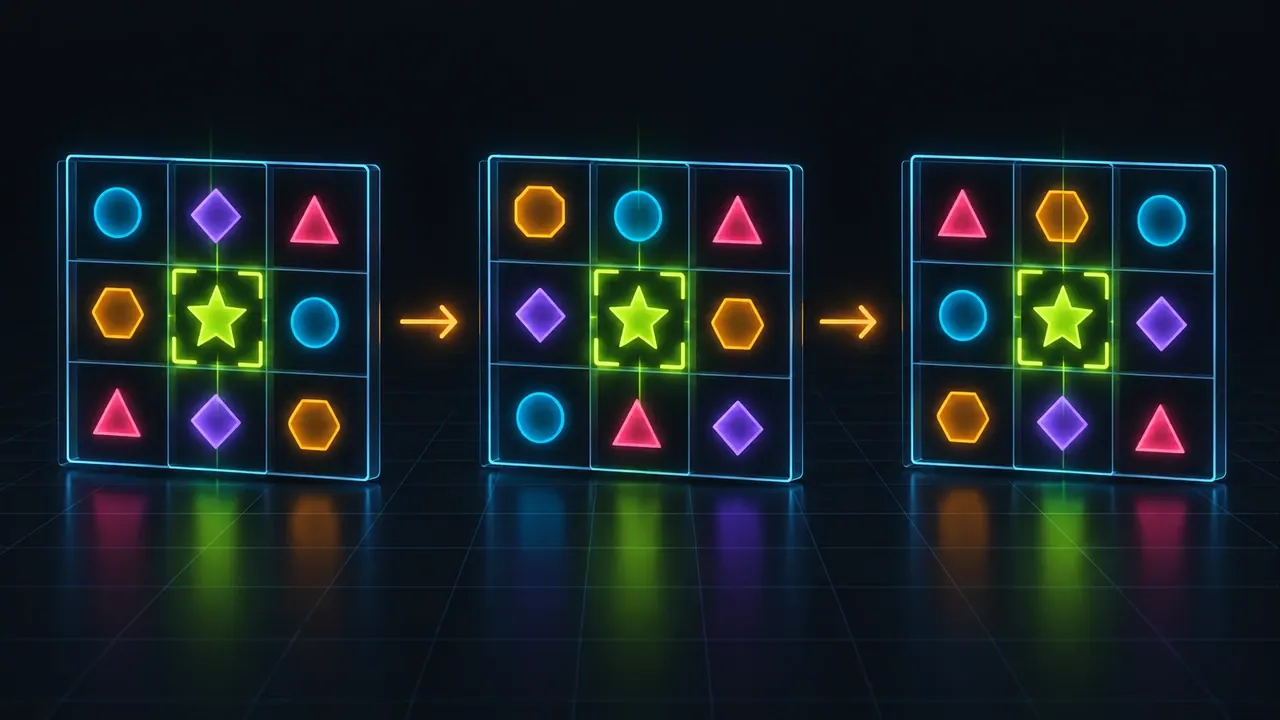
The xNudge wild: a wild that finishes arriving after the reels stop
An xNudge wild is taller than one position. When it lands with part of itself above or below the visible grid, the reel it occupies moves it until the whole symbol is in view. That movement is the nudge, and it is not decoration: the game counts the steps and attaches a multiplier to the wild reflecting how many were needed.
The consequence people miss is that a wild landing fully in view nudges zero times. The nudge is a correction, not a bonus, so a wild sitting perfectly placed when the reels stop carries the smallest multiplier the design allows, and one that landed almost entirely off the grid carries the largest. The visually tidiest board produced the least.
How many steps are possible depends on the wild's height and the height of the reel it landed on, both build figures in the panel. What is structural is the relationship: a longer nudge means a larger multiplier, and that multiplier belongs to the wild rather than to the spin. If the wild forms no part of a winning combination, the number beside it does nothing.
That produces the commonest complaint about this title, and it is mechanical rather than a fault. A multiplier is not a prize; it needs a win to act on. Round history, where the build offers one, settles the question better than memory, because at speed the nudge animation and the win evaluation read as a single event.


18+ · Bonus conditions
Offer information supplied: 2026-10-05.


18+ · Bonus conditions
Offer information supplied: 2026-10-05.
Why xNudge multipliers add together instead of multiplying
When two or more xNudge wilds appear on the same board and take part in the same win, their multipliers are summed and the sum is applied once. They are not multiplied by one another. This is the rule the studio states for the mechanic, and also the most often misreported, because every instinct trained on other studios says two multipliers compound.
The difference is large enough to work. Read the step value from the panel, so a wild nudged n times contributes n steps' worth plus whatever base the design gives it. For wilds contributing a, b and c the board multiplier is a plus b plus c; compare that against a times b times c. With three or four wilds the two models diverge by an order of magnitude.
Addition has a second-order effect worth naming. Because values add, each extra wild's marginal contribution is roughly linear rather than explosive, so the enormous outcomes here do not come from stacking wilds alone. They come from a large summed multiplier landing on a win already enlarged because the grid was split.
Whether any carried or persistent multiplier exists inside a feature is a separate question with a separate answer in the rules, and it differs between titles in this catalogue. Do not assume behaviour seen in another of the studio's games applies here; read the feature's own paragraph in the panel for this build.
The xSplit symbol: cutting the grid in two and what that buys
The split device divides what it lands on. Symbols in its path become two symbols, the positions they occupied become two positions, and the affected reels become taller. The grid after a split is not the grid the spin began on, and the ways count the paytable uses is recalculated to match the new shape.
That recalculation is why a split changes a board so sharply. A ways count is the product of the row heights across the reels: double one reel's height and the ways count doubles, double two and it quadruples. The device multiplies the counted ways geometrically rather than adding to them, which is a different kind of change from anything a wild does.
Illustrative figures show the geometry without teaching this game's numbers. Take reel heights of two, three, three, three, two: the ways count is 2 x 3 x 3 x 3 x 2, which is 108. Split the two middle threes into sixes and the heights read two, six, six, three, two: 2 x 6 x 6 x 3 x 2 is 432. Same board, four times the counted ways. The heights in your build are in its panel and are not these.
A split does not rescue a losing board, since doubling the ways across an arrangement with no qualifying combination doubles nothing. Where the split symbol can land, how many reels it affects, and whether an already-split symbol can be split again are stated in the loaded rules rather than being universal properties of the mechanic.
// sponsored · Safe Casino · 18+
+500% + 120 free spins
Safe Casino welcome offer. Check the qualifying deposit and wagering conditions before you claim.
When a split reel meets a nudged wild: the compounding board
The interaction is where this game's reputation comes from. A split makes reels taller, and a taller reel gives a tall wild more room to land partly off the grid and more room to nudge once it has. A board already split is one on which the nudge device has more scope to generate large multipliers, applied across a ways count that has just been multiplied.
As a chain it reads: split raises row heights; raised heights raise both the ways count and the available nudge distance; the longer nudge raises each wild's multiplier; the multipliers add; the sum applies to wins counted across the enlarged ways. Each link is modest. The chain is not, and it is why the outcome distribution has a very long, very thin tail.
The honest reading of that chain is the uncomfortable one. A mechanism whose large results require several things to coincide produces them rarely by construction. The rarity is arithmetic, not bad luck and not a cold machine, and nothing published describes how often those events coincide. This page will not estimate it.
It also explains why most spins look flat. The design spends the overwhelming majority of its return in the rare compound board rather than in ordinary wins, so an ordinary spin is quieter than on a lower-volatility game with the same return. That difference in feel describes distribution shape, not whether either game is paying correctly.
Figures differ between builds and lobbies. Read the live game's information panel before you rely on any of them.
Play here →Entering the bonus: scatters, variants and what the panel decides
This studio commonly offers more than one feature route, with different entry conditions and different in-feature rules, and in several titles the devices above behave differently inside the feature than outside it. Which routes exist here, what triggers each and how many spins each awards are stated in the loaded build's rules, and differ by build and release version.
Worth knowing before you look is which questions to put to that panel. Ask what triggers entry; how many spins are awarded; whether a retrigger exists and whether its condition differs from entry; whether any multiplier or position persists between spins; and whether the split device is more frequent, guaranteed or absent inside the feature.
Persistence changes the arithmetic most. If a multiplier or split state carries across spins within a round, the order events arrive in decides the round's size, and an event on the first spin is worth far more than the same event on the last. If nothing persists, each feature spin is a base-game spin with a different symbol set and order is irrelevant.
Where a build offers a feature purchase it carries its own separately stated return figure, frequently different from the base game's, and that is the figure describing what you are doing. Read the charge in your own account currency at the confirmation step. Whether such a stake counts towards a promotion is an operator term, and operator shortlists and bonus offers are pokiesledger.com's subject rather than this site's.

Reading the volatility rating honestly, not as a payout forecast
Nolimit City prints a volatility rating in its information panels, and the rating that applies to Deadwood is the one in the panel of the build you load rather than one carried over from a review. That rating describes the shape of the outcome distribution. It is not a score, not a quality judgement and not a statement about how much the game pays: a high rating says the return is concentrated into rare, large results.
Two games can share a return and sit at opposite ends of a volatility scale. One pays small amounts often; the other pays almost nothing for long stretches and then occasionally pays a great deal. The two words answer separate questions: a rating speaks to when and in what sizes the designed return arrives, while the return figure speaks to how much of it there is to arrive at all. Collapsing one into the other is what turns a high rating into an imagined promise.
Ratings are also not comparable across studios. Each provider defines its own scale with its own thresholds, so the top of one studio's five-point scale and the top of another's are two different claims by two different parties using the same word. Comparing them as a shared unit is reading marketing copy as measurement.
A decision rule follows from the shape rather than the rating. Where return concentrates in rare boards, a typical session result sits further below the average than on a flatter design, because the average is held up by outcomes most sessions never contain. The rating is not a schedule either: nothing becomes due, and no state carries between rounds beyond what a feature's rules persist.
// sponsored · WinCrown · 18+
+500% + 120 free spins
WinCrown welcome offer. Read the current promotion terms, eligibility and withdrawal conditions.
The return: why no percentage is printed on this page
No return figure for Deadwood appears here, and the reason is specific rather than coy. Studios distribute titles at more than one return configuration, the choice of which to integrate belongs to the operator, and nothing on the surface of the game announces which is loaded. A percentage accurate in one lobby can be wrong in the next.
Modes compound that. Where a build offers a feature purchase or an alternative bet mode, each carries its own figure in the same panel. A single quoted number would have to match both the configuration the operator integrated and the mode you are about to use, and one figure copied from a review cannot match both at once.
The procedure is short and worth doing once per lobby. Open the title, reach its rules through the help control inside the game frame itself rather than through the lobby's own description of it, and read the figure printed against the mode you are about to select, base game or purchase. Where frame and surrounding page disagree, the frame is describing the integration you will actually be spinning.
Whatever figure that panel gives is modelled over a round count no player will ever sit through, so it characterises a long run rather than an evening. It is not a schedule and it does not apply to your session. Return and volatility answer different questions and usually sit within a line or two of each other in the panel; reading only one is how wrong expectations about this title get formed.
The maximum win cap, and the sum that collides with it
Every build states a maximum payout as a multiple of stake, and here the cap is not a distant curiosity. It is the ceiling the compounding board runs into, because a large summed multiplier applied across a multiplied ways count is precisely the arrangement that reaches a cap in a single evaluation.
A cap does not quietly trim a result in the background, so read what the loaded rules say happens when the limit binds. Three definitions circulate and they are not interchangeable: whether the round terminates immediately, whether remaining feature spins are forfeited or played out, and whether the limit applies per spin, per round or per feature.
The relationship can be made concrete with the panel's own two numbers and nothing invented here. Take the cap m from the panel, in multiples of stake, and the board multiplier M you worked from the summed nudge values. A win paying w times stake before multipliers reaches the cap when w times M is at least m, so m divided by M gives the pre-multiplier win size at which the cap binds.
On this title the maximum-win definition earns priority over the return figure, if only one line is going to be read before the first spin. Where multipliers sum and ways multiply, the limit's scope decides whether a feature that is building keeps running. What happens to money after a capped round is an account matter: withdrawal limits, verification and processing are covered on pokiescashout.com.
A nine-line check inside the information panel before staking
Nine lines, in this order, read once per lobby before the first real-money spin. One, the return figure for the mode you intend to use. Two, the volatility rating as that studio states it. Three, the grid's row heights and the ways count they produce. Four, the maximum win as a multiple of stake. Five, the scope of that maximum: per spin, per round or per feature.
Six, the nudge rule: what a single nudge step is worth, and confirmation in writing that multiple xNudge multipliers add rather than multiply. Seven, the split rule: which reels the device can affect and whether an already-split symbol can be split again. Eight, the feature entry condition and the spin count awarded. Nine, whether anything persists between spins inside a feature.
If any of those nine comes back empty, the game is unread rather than fine. Every one is a build fact, which is why the answers do not travel between lobbies: the same title integrated by a second operator can carry a different return configuration, and a demo reached through a search engine can be a different release from the one an operator integrated.
The help control to use is inside the game frame, not the casino page's own description of the title. Operator copy is written by a different party from the one that built the machine, is frequently stale, and is never authoritative over the panel. Doing this once per lobby is the part people skip, because the nine answers are properties of an integration rather than of a name.
Watching a tall split grid on a phone, and finding the game
This design loses something specific on a handset, and it is not the artwork. When the split device raises row heights, a portrait layout shrinks every symbol to fit the taller grid into the same width. The multiplier printed on a nudged wild is among the smallest elements on screen, and it is the one you most need to read on the board that matters.
The ways-count readout suffers the same compression, competing with the win counter and the balance in one strip. Since the point of the split device is that the ways count changed, a layout hiding the change makes the mechanic invisible exactly when it fires. Landscape restores most of that, and turning off turbo and autoplay is the only way the nudge sequence is legible at human speed.
If you go looking for the title in an offshore lobby such as Safe Casino or WinCrown, searching the exact game name is more reliable than browsing a provider category, since studio category pages are marketing assets rather than live indexes of what is integrated — whether this release is stocked at all, and at which configuration, only that lobby's own search and the loaded panel can answer on the day.
Two further cautions. A tile is written by the operator and can truncate or alter a title, so read the full name from the game's own header or the first screen of its help panel. And online casino services cannot lawfully be provided to people in Australia, which is the ACMA's stated position, so any operator you reach is offshore. Whether one is worth an account is pokiesledger.com's subject; how money moves is pokiescashout.com's.
What this page deliberately did not assert
Taken as structural and expected to survive a reconfiguration: that Deadwood is a Nolimit City title; that it uses the xNudge wild device, in which a partly visible tall wild is nudged fully into view and gains multiplier value for the steps taken; that those multipliers are summed rather than multiplied; that it uses a split device dividing symbols and rows and thereby recalculating the ways count; and that the studio states a volatility rating for the title in the game's own information panel.
Deliberately absent, because it is build-specific and not establishable from outside a live lobby: the return percentage for any mode, the grid's row heights, the ways count, the value of a single nudge step, the maximum height of a wild, how many reels the split device can affect, feature entry conditions and spin counts, the retrigger rule, the maximum win multiple and its scope, the price of any feature purchase, and whether any particular operator has integrated this release.
The illustrative arithmetic above — reel heights of two, three, three, three, two, and the figures 108 and 432 — was chosen to make the geometry of a ways count legible. Those numbers are not read from any build of this game and should not be repeated as if they were. Declining to print the rest is this network's house style, not a gap in the research.
Nothing here is a strategy, and nothing described changes the game's designed return. Set a spending and time boundary before the game is open rather than during a round: a design whose upside needs several rare things to coincide is unusually good at producing the sense that the last board came close, and nothing above tells you whether it did. Some links on this site are commercial and can earn the publisher a commission. This is a description of a machine, for adults only.
Questions people actually ask
What is the RTP of Deadwood?
There is no single figure to quote. Titles ship at more than one return configuration and the operator chooses which it integrates, so the number that applies to you is the one in the information panel inside the game frame, in your lobby, on the day. Where the build offers a feature purchase or an alternative bet mode, each carries its own separately stated figure in that same panel.
How volatile is Deadwood really?
The rating that applies is the one printed in the panel of the build you load, and the mechanics explain why it falls where it does: the large outcomes need a split board, a tall wild landing awkwardly inside it, and a qualifying combination using that wild. A high rating describes the shape of the distribution — return concentrated into rare, large results — and says nothing about how much the game returns. Ratings are also not comparable between studios.
Do xNudge multipliers multiply together?
No. When several xNudge wilds take part in the same win, their multipliers are summed and the sum is applied once. This is the rule most often misreported, because other studios' games train the opposite instinct. With three or four wilds the two models differ by an order of magnitude, so confirm the wording in your build's panel before working any arithmetic.
Why did a wild with a big multiplier pay nothing?
A multiplier is not a prize; it needs a winning combination to act on. A wild carrying a large number that combines with nothing contributes nothing, and the value is not carried to a later spin unless a feature's own rules say so. Round history, where the build offers it, settles this better than memory, because the nudge animation and the win evaluation read as one event at speed.
Does a wild that lands fully in view still get a multiplier?
It nudges zero times, so it carries the smallest multiplier the design allows. The nudge is a correction rather than a bonus: the game counts how many steps were needed to bring a partly off-grid wild fully into view, so a wild that landed almost entirely off the grid carries the largest value and a perfectly placed one carries the least.
What does the xSplit symbol actually do to the ways count?
It divides symbols and rows, which raises the affected reels' heights, and a ways count is the product of the row heights across the reels. Doubling one reel's height doubles the ways; doubling two quadruples them. The change is geometric rather than additive, which is why a split board can register far more simultaneous combinations than the board it replaced.
What happens if a spin reaches the maximum win?
That depends on the rule stated in the loaded panel, which is why it is the line worth reading before the first spin. Check whether the round terminates immediately, whether remaining feature spins are forfeited or played out, and whether the limit applies per spin, per round or per feature. The same board totals differently under each definition.
Is Deadwood licensed for play in Australia?
No operator offering it is. The ACMA's position is that online casino services cannot lawfully be provided to people in Australia, so any lobby you reach carrying this title is offshore and may provide no Australian consumer protection. The game itself is a studio product; the licence question belongs to whichever operator has integrated it.
// next step
A paytable makes more sense with the game open in front of you.
View current offer