- Studio
- Hacksaw Gaming
- Grid
- 5 reels x 3 rows, 15 cells
- Core feature
- Mystery symbol conversion
- Volatility driver
- Few cells, one revealed symbol
- RTP, cap, paylines
- In-game info panel only
Fifteen cells: what a five-by-three board rules out
Count the board before reading anything else about this game. Five reels, three rows, fifteen visible positions. That number is not trivia: it sets a hard ceiling on how much can happen in one spin, and every feature in the game exists to work around that ceiling rather than to decorate it.
Put it beside the boards most modern pokies use. A six-by-five cluster grid shows thirty cells, twice as many, and a reel-modifier engine that varies symbol counts per reel can show far more. On a thirty-cell board a win can form in one corner while the rest of the screen does something else, and a cascade engine can clear four cells and refill them without the screen ever looking empty. Fifteen cells has no spare room for that. There is no quiet corner; there is the screen, and it is either doing something or it is not.
The consequence is structural. A wide board spreads outcomes across many small events — a short cluster, a refill, a modest line win returning part of the stake. A compact board cannot spread anything. The same expected return has to arrive through fewer, larger, rarer events, because there is no space to deliver it through many small ones. That is neither a flaw nor a favour; it is a description of where the game puts its outcomes.
It also means the game cannot be read like a cascade pokie. There is no partial progress to track across a spin and no board state carrying into the next one unless your panel says otherwise. So the first practical move is the dullest: open the game, find the information icon inside the game frame rather than on the casino page around it, and read the first line of the rules — the grid, and how a win is recognised on it. Everything below depends on that answer.


18+ · Bonus conditions
Offer information supplied: 2026-10-05.


18+ · Bonus conditions
Offer information supplied: 2026-10-05.
How the mystery symbol resolves, and what the panel must tell you
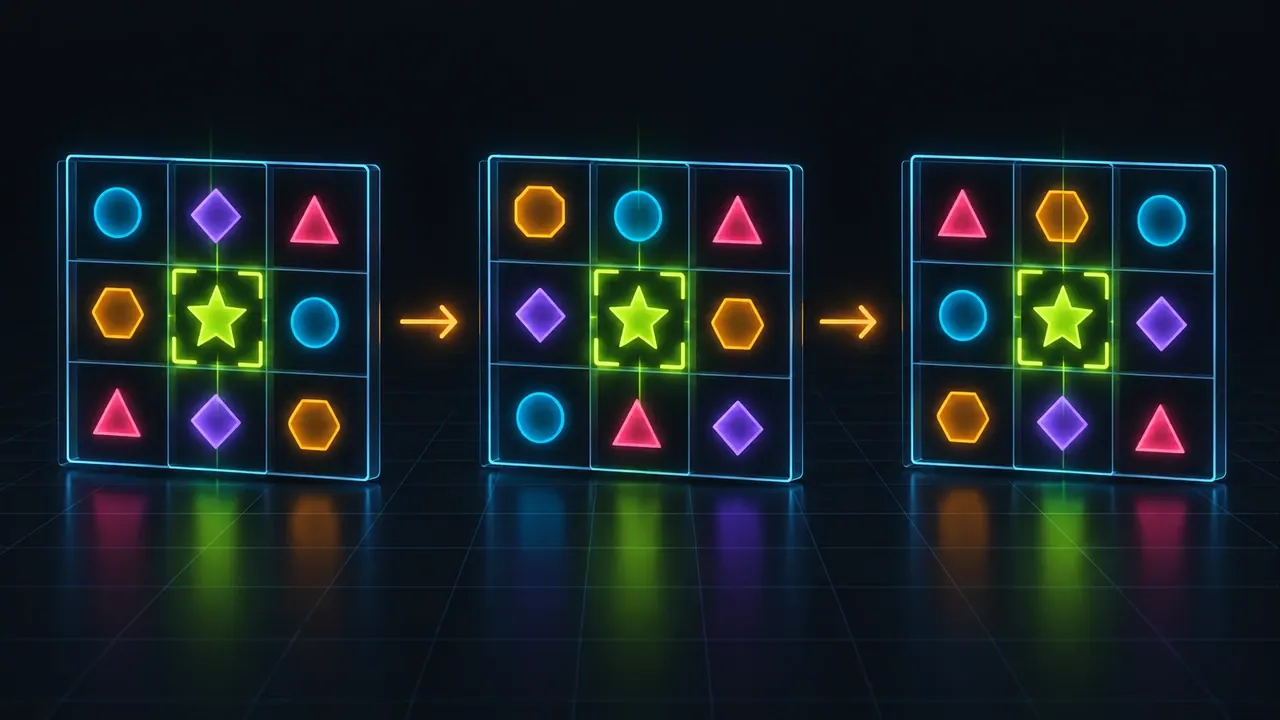
A mystery symbol is a placeholder. It lands looking like nothing in particular, occupies a cell, and pays nothing in that state. At some point in the spin it is replaced by a real symbol, and from then on it behaves exactly as if that symbol had landed there to begin with. The interest of the mechanic is entirely in the replacement rule, not in the placeholder.
The rule that makes this game what it is, and the one to confirm in the panel rather than assume: whether all mystery cells resolve to the same symbol, or each resolves independently. The two designs look identical for the first half-second of animation and produce different games. Independent resolution scatters random symbols into random cells and mostly produces nothing. Shared resolution turns every mystery cell into one symbol simultaneously, which is how a small grid generates a full-screen result from positions that were individually worthless.
Three clauses sit underneath that and are routinely skipped by summaries. First, when the resolution happens — before win evaluation, after an initial evaluation, or at the end of a respin sequence. Second, whether the revealed symbol can be the top payer, a low symbol only, a wild, or a scatter, because a mystery cell that can resolve into a scatter is simultaneously a feature trigger and a pay symbol. Third, whether mystery cells appear on every reel or only some.
There is a fourth question that only matters on a compact board, and it is the one to carry away: what happens when the cells resolve into a symbol that forms no win. On fifteen cells that is common, because the cells must land in the right relationship to each other and few relationships are available. A reveal is not a payout. The screen going loud at the moment of resolution is sound design, not information about your balance.

Worked arithmetic: four marked cells, one revealed symbol
Work a concrete case, because the mechanic is easy to describe and easy to misjudge. Say four mystery cells are showing when the reveal fires, and all four resolve to the same mid-ranking symbol. What that is worth depends entirely on how the game recognises a win, and there are three common answers.
On fixed paylines running left to right, the four cells must sit on reels one, two, three and four — one per reel — and on positions a declared line actually passes through; four cells crowded onto two reels pay nothing at all, however bright the animation. On a ways engine the reel spread still matters but the row does not: one matching symbol on each of the first three reels is a three-of-a-kind wherever it sits. On a cluster engine the reels stop mattering and adjacency takes over, so four touching cells may qualify while the same four spread across the grid do not.
Same four cells, same revealed symbol, three different results. That is why the win-recognition line in the panel is not a formality, and why a video of somebody else's spin proves nothing about your build unless you know that line matched.
Now scale the reveal. Six cells resolving as one symbol on a fifteen-cell board means forty per cent of the visible screen became the same thing at once; ten cells means two thirds of it. A thirty-cell board would need twenty cells to reach the same proportion, and no compact design needs to move twenty cells — which is the point. The small board makes a proportionally enormous event out of a modest number of conversions. The honest half of that: fifteen cells also offer fewer distinct positions a win can occupy, so there are fewer routes to a result and longer gaps between results. The mechanic does not add return; it relocates it.
// sponsored · Safe Casino · 18+
+500% + 120 free spins
Safe Casino welcome offer. Check the qualifying deposit and wagering conditions before you claim.
Why fifteen cells swing harder than thirty
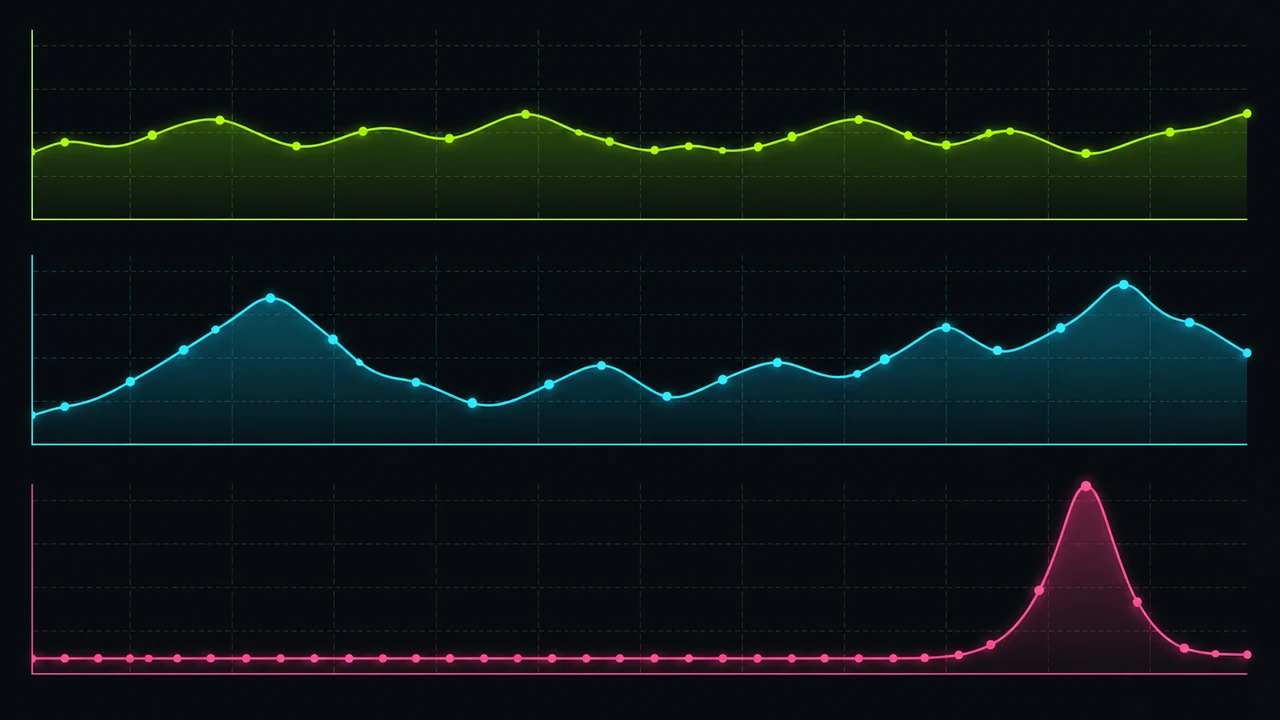
Volatility is not a measure of how generous a game is. It measures how far individual results scatter around the average, and that scatter is set by the shape of the pay distribution rather than by the return percentage. Two games can share an identical return figure and feel like different hobbies; this is the end of the spectrum where outcomes are few and large.
Three features of a compact mystery-symbol design push the same way. Fewer cells means fewer simultaneous small wins. A shared reveal means the board's outcomes are correlated rather than independent, so when something happens it happens across many cells at once. And a design leaning on one headline event funds it by paying less often elsewhere, because total return is fixed by the configuration rather than by enthusiasm.
Here is what that does to a session in plain numbers. Take two games with the same return figure, one paying something back on roughly one spin in three and one on roughly one in five. Across three hundred spins the first produces around a hundred results and the second around sixty, so the second must pay about two thirds more per result to land in the same place. Hit frequency and average win size are tied together by arithmetic, not by preference, and at a fixed return a game cannot be both frequent and explosive.
The reading rule follows: on a game shaped like this, the volatility rating in the panel tells you more about your evening than the return percentage does. A return figure averages over far more spins than anyone plays in a sitting; a volatility rating describes the shape of the three hundred you will actually see. The rule that does not follow, however often it is implied: none of this can be timed or encouraged. Spins are independent, a long flat run is not stored progress, and no stake pattern or session length changes a designed return.
Figures differ between builds and lobbies. Read the live game's information panel before you rely on any of them.
Play here →Reading the pay table: symbol ranks and multiples of stake
Pay tables on this kind of game are expressed as multiples of total bet, which is the useful format because it makes every figure independent of what you happen to be staking. A symbol paying twenty times stake pays four dollars at twenty cents and forty dollars at two dollars. Read the whole table in multiples and convert once at the end.
Read it in a fixed order. One, the top symbol's highest-count payout, which sets the scale of the table. Two, the ratio between the top symbol and the next one down, which shows how steeply the game is weighted towards one outcome. Three, the lowest-paying symbol's full-count payout, which is the floor of a complete win. Four, whether a wild exists, what it substitutes for and whether it pays in its own right. Five, the scatter or feature symbol and how many are needed.
Step three deserves lingering on a compact board. If the lowest symbol's best payout is a small fraction of the stake, a filled screen of low symbols is a loss dressed as an event — and on fifteen cells that happens often. Knowing the figure in advance is what stops a reveal reading as a win when the balance says otherwise. Step two is the best single predictor of feel: a table where the top symbol pays several times the second is routing return through one narrow outcome, while a flatter table spreads it.
Then do the one conversion that matters before the first real-money spin. Take your intended stake and multiply the top symbol's best payout by it. That dollar figure is what the game's headline symbol is actually worth to you at your stake, and it is usually smaller than the animation implies. Repeat for the lowest symbol and you have the real range of a complete win on your board.
The RTP question: why one number cannot be printed here
If you came for the return figure, the answer is a procedure rather than a percentage, and the reason is specific rather than evasive. Studio output of this kind can ship in more than one return configuration, and which configuration is loaded is the operator's integration decision rather than a property of the game's name. A number printed beside a title on a review page is a snapshot of one build, in one lobby, on one day.
So any figure quoted here would be wrong for some readers and unverifiable for the rest. This network does not print them. What it prints is where the correct one lives: the information panel inside the game frame, in the lobby you are playing in, loaded at the stake you intend to use. Collect five values while you are there — the base-game return, any separate return stated for a bonus buy, any separate return stated for an enhanced-chance mode, the maximum win as a multiple of stake, and the volatility rating.
It is worth knowing what a difference between configurations is actually worth, because the figure gets discussed as though it were the whole game. Two builds two percentage points apart differ by two cents in every dollar of turnover. Five hundred dollars of turnover at that gap is a ten-dollar difference in expectation: real, worth preferring the better build, and far smaller than a single spin's variance on a game shaped like this.
One trap on return figures catches almost everyone. A game's return applies to turnover, not to deposits. Three hundred spins at one dollar is three hundred dollars of turnover even if you only ever put fifty in, because winnings staked again are turnover too. Any expected-cost estimate has to be built on the turnover figure, which is nearly always much larger than players assume.
// sponsored · WinCrown · 18+
+500% + 120 free spins
WinCrown welcome offer. Read the current promotion terms, eligibility and withdrawal conditions.
The win cap: a termination condition, not a trophy
Nearly every modern pokie states a maximum win as a multiple of stake, and on a high-volatility design that figure does more work than players credit. It is not a remote theoretical ceiling. It is a rule that can end a round in progress, and on a game routing its return through rare large events it sits nearer the top of the distribution than it looks.
Do the conversion in your own currency immediately. Call the multiple your panel states C. At a twenty-cent stake the ceiling is C times twenty cents; at two dollars it is C times two dollars. Same cap, same game, a tenfold difference in the dollar figure — so the cap is not a fixed prize but a function of how you are staking. Players who read the multiple and never convert it are carrying around a number that does not describe their own game.
Then read the three clauses deciding what the cap actually truncates. Whether it applies per spin, per round, or per feature. What happens to anything still pending when it is reached — remaining free spins, an unresolved respin, a multiplier yet to apply. And whether a reached cap pays out and ends the round, or pays out and lets the round continue at no further value. Those answers differ between titles from the same studio and cannot be inferred from the number.
The structural point for this game specifically: a mechanic that can convert most of a small board at once is a mechanic capable of producing a very large single result, which is precisely the shape of outcome a cap exists to bound. On a game paying in many small pieces the cap is close to irrelevant; here it is part of the pay table and should be read as part of it. Reading the cap is not the same as expecting it — the probability attached to it is remote by design.
Feature entry, buys and enhanced-chance spins: three products
Features on this kind of game are usually reachable three ways, and they are not interchangeable. Waiting for the trigger symbols is free and uncertain. A bonus buy pays a stated price to start the feature immediately. An enhanced-chance mode sells ordinary spins at a raised price with improved odds of triggering, which means the premium can be paid repeatedly with nothing triggered at all.
That third product catches people, and the mechanism is simple arithmetic: if a mode charges several times the normal stake per spin, each spin is several times the turnover, so a run of them consumes a balance several times faster whether or not a feature arrives. Check whether your build offers it, and if it does, check the per-spin charge rather than the advertised improvement.
Before touching a buy, establish four things in your account currency rather than in stake multiples. The total charge the confirmation screen shows. Which feature the button enters, because a studio shipping graded features sells more than one price point and the cheaper one is a different product. Whether the mode states its own separate return figure, as these commonly do. And whether the cap applies to a purchased round the same way it applies to a base-game spin.
Keep the account terms in a separate column while you do it. A purchase counted at its full charge can breach a maximum-bet-while-wagering condition, and feature purchases are frequently excluded from bonus wagering contribution altogether. Understanding the mystery reveal perfectly will not help with a refused withdrawal. Which operator's offers are worth claiming at all is pokiesledger.com's subject, not this site's, and deposits, withdrawals and KYC belong to pokiescashout.com.
Stake, round count and the turnover arithmetic
The cost of playing any pokie is a fraction of turnover, and turnover is stake multiplied by the number of rounds. That is the only equation here that applies everywhere and survives every build difference, which makes it the one to fix before a session rather than after.
Run the numbers, because they are worse than instinct suggests. Fifty cents across four hundred spins is two hundred dollars of turnover; one dollar across the same four hundred is four hundred. A pokie with short rounds and no cascade animation delivers spins quickly, and an autoplay setting delivers them faster still, so the round count is the variable that moves hardest without anyone deciding to move it.
Set both numbers in advance and in this order. First the total amount you are prepared to lose, which is a dollar figure and not a number of spins. Second the stake, chosen so that figure survives a realistic run of nothing — and on a high-volatility design a realistic run of nothing is long enough to be uncomfortable. Third the round count or the clock, whichever is easier to notice.
A specific warning for a game that pays rarely and largely. The temptation is to raise the stake during a flat patch, on the reasoning that the eventual event should be worth more when it arrives. The flat patch carries no information about the next spin, and raising the stake raises turnover immediately while changing nothing about probability: the cost goes up now, the distribution does not move. Autoplay deserves its own line, because it detaches the round count from any decision — if you use it, set a spin limit and a loss limit inside the tool before starting.
On a phone: small grid, small panel, fast rounds
Most Australian play happens on a phone, and a compact grid is the one case where the small screen is not the main problem. Fifteen cells fit a portrait frame comfortably and the symbols stay legible. What does not fit comfortably is everything around the grid, and that is where the readable information lives.
Find three controls once per operator, before the session rather than during it. The information panel, which on a phone sits behind a menu inside the game frame rather than beside it. The stake selector, and specifically whether it is a slider or a list, because a slider is the control most likely to move a stake by a factor you did not intend. And the round history view, which is the only record of what a loud spin actually settled at.
Check both orientations if you switch between them, because control positions, the confirmation dialog for a purchase and the history view can each sit elsewhere in portrait and landscape. A mis-tap on a game where a purchase price is a multiple of stake is an expensive way to learn where a button lives.
The round history is worth more here than on most games. On a design paying rarely and largely, memory of a session skews badly: the reveals are vivid and the three hundred spins between them are not. The history view is an unflattering, accurate record, and reading it at the end of a session is the cheapest correction available. Understanding the conversion does not change what the conversion is designed to do — decide a spending limit and a time limit before opening the game, never use money needed for essentials, and if the reason for the next spin has become the last one, the support guide is a more useful page than this one.
Where it turns up, and what this page did not verify
On availability this page asserts nothing, because catalogues change without notice and a title present last month may be absent today. If you want to know whether this release is in front of you now, a lobby's own provider filter is the only current answer — on Safe Casino and WinCrown, the sponsored lobbies on this site, that filter is where a Hacksaw listing would appear if one is carried, and whether this particular title sits behind it on the day you look is not something this page claims either way.
The legal position needs saying plainly rather than in a footer. The ACMA's position is that online casino services cannot lawfully be provided to people in Australia, and every operator referred to anywhere on this network is offshore. A familiar studio's logo in a lobby footer is not an Australian authorisation and does not create one. Offshore services may not carry Australian consumer protection, and where a round, a balance or a bonus is disputed the escalation path runs to the operator and then to its offshore licensor, and stops there.
What this page did not verify, stated rather than hidden: no return percentage, because the figure is build-specific and the configuration is the operator's integration choice; no payline, way or cluster count, because win recognition is the first line of the panel to read and the panel is the authority; no symbol payout, multiplier ceiling, trigger count or maximum-win multiple; no price for a bonus buy or an enhanced-chance mode, and no assertion that either exists in your build; and no claim about release dates, series ordering or which operators have integrated the title. Figures remembered from a sibling release are guesses wearing a decimal point, so record the full title from the game header rather than the lobby tile.
What is stable, and what this page is built on, is structural rather than numeric. A compact grid holds few cells. A mystery symbol pays nothing until it resolves. A shared resolution correlates the whole board, concentrating outcomes into fewer and larger events. Caps bound those events. Turnover equals stake multiplied by rounds. None of that changes between builds, and all of it can be checked against the panel in front of you in about two minutes. Commission can be earned on sponsored links elsewhere on this site, which changes none of the arithmetic above.

Questions people actually ask
What is the RTP of Chaos Crew?
It depends on which build the operator integrated, and a title of this kind can ship in more than one return configuration. Any bonus buy or enhanced-chance mode commonly carries its own separately stated figure as well. All of them appear in the information panel inside the game frame, in the lobby you are playing in, and that is the only version of the number that applies to your session. This site does not reprint return figures copied from elsewhere, because they describe one build on one day.
How does the mystery symbol work?
A mystery symbol occupies a cell and pays nothing in that state, then resolves into a real symbol and pays as if that symbol had landed there. The rule to confirm in the panel is whether every mystery cell resolves to the same symbol or each resolves independently — shared resolution is what lets a small board produce a near-full-screen result, while independent resolution mostly produces nothing. Also check when the resolution happens and which symbols it can produce.
Why does a big reveal sometimes pay nothing?
Because a reveal is not a payout. The revealed symbol still has to land in a winning relationship under whatever rule your build uses: one per reel on a declared payline, a reel spread on a ways engine, or adjacency on a cluster engine. On a fifteen-cell board there are not many qualifying arrangements, so reveals settling below the stake are routine. The animation fires either way; the balance is the result.
Is Chaos Crew high volatility?
The rating in the information panel is the authority for your build, and this page does not substitute a figure for it. Structurally, a compact grid with a shared reveal is the shape that concentrates outcomes: fewer cells mean fewer simultaneous small wins, and a correlated board means results arrive in a few large pieces rather than many small ones. At a fixed return, paying less often and paying more per result are two sides of the same arithmetic.
Does a small grid mean worse odds?
No. Grid size sets the shape of the pay distribution, not the return percentage, and the return percentage is set by the configuration the operator loaded. A fifteen-cell board routes the same return through rarer, larger events than a thirty-cell board does. That is a difference in variance rather than in value, and the volatility rating in the panel is where it is described.
What is the maximum win on Chaos Crew?
It is stated in the panel as a multiple of stake, and this page does not quote a multiple it cannot verify for your build. Convert it yourself: if the panel reads C times stake, the ceiling is C times twenty cents at a twenty-cent stake and C times two dollars at a two-dollar stake. Then read whether the cap applies per spin, per round or per feature, and what happens to anything still pending when it is reached.
Is buying the feature better value than spinning for it?
They are different products and the panel is the only place to compare them. A buy pays a stated price to enter immediately; an enhanced-chance mode sells ordinary spins at a raised price with better trigger odds, so the premium can be paid repeatedly with nothing triggered. Check the total charge on the confirmation screen in your own currency, which feature the button enters, and whether the mode states its own return figure. Purchases are also frequently excluded from bonus wagering.
Can I improve my results on a game like this?
No. Spins are independent, a flat run carries no information about the next spin, and no stake pattern, session length or stopping rule changes a designed return. Raising the stake during a quiet patch raises turnover immediately and moves the distribution not at all. What reading the panel does buy you is an accurate picture of what the game is, which is worth having for its own sake.
// next step
A paytable makes more sense with the game open in front of you.
View current offer