
- Provider
- Nolimit City
- Core mechanics
- xWays, xNudge, Enhancer Cells
- Feature
- Lockdown Spins
- Return
- Multiple builds; read the panel
- Max win
- Capped as a multiple of stake
A board that starts narrow and is built to grow
San Quentin xWays belongs to Nolimit City's run of dark-subject releases, alongside Mental and Deadwood; the studio's own game page carries the release date and version history if you want it dated. Its reels are not a rectangle: the outer reels hold fewer symbol positions than the inner ones, and the resting ways count in the information panel describes that starting shape only. It is the smallest board the game will ever show you.
The asymmetry is deliberate. The reels that begin short are the ones the game intends to interfere with, and every mechanic here does one of two things: it adds symbol positions, or it adds a multiplier. Nothing pays by aligning symbols across a board of fixed height the way a club cabinet does, which is why a win often looks unrelated to the final arrangement.
So the ways figure is live and changes mid-spin. A spin that resolved at the resting layout and one that finished several positions taller are different events counted on different numbers of ways, and the game produces both inside a session without labelling which you are watching.
Round history is the tool for reading a result, not memory of the animation: it states what was counted, on how many ways and at what multiplier, in the order applied. Reconstructing a round from the final screen is unreliable in principle, because that screen is the end of a sequence of structural changes rather than a record of it.


18+ · Bonus conditions
Offer information supplied: 2026-10-05.


18+ · Bonus conditions
Offer information supplied: 2026-10-05.
What an xWays symbol does to the reel it lands on
xWays is the mechanic named in the title and it is structural, not a payout. The provider's description is consistent across the xWays titles: the symbol reveals a number of matching symbols and expands the height of the reel it occupies, so a reel that held one position now holds several showing the same symbol.
Do the count by hand once, because the arithmetic explains the game. Ways are a product across the reels, not a sum. On a board whose reels hold 3, 4, 4, 4 and 3 positions the product is 3 × 4 × 4 × 4 × 3 = 576 ways; grow the first reel to five positions and it becomes 960, an extra 384 ways bought with two positions on one reel. Those figures illustrate the behaviour; this title's counts are in the panel.
Because the relationship is multiplicative, two or three expanded reels are not a better version of one; they are a different-sized machine. It is also why a low-ranking symbol can return a large total here: the total depends on how many ways existed when the win was counted, so a modest symbol across hundreds of ways beats a premium across a handful.
What xWays does not do is multiply anything. An expanded reel carries no multiplier of its own; it only creates more chances for the same symbols to connect. Keeping that separate from the nudge multiplier is the most useful distinction available on this title. Whether expansion can reach every reel, and whether an expanded reel persists into the next spin, are rules questions whose answers differ between Nolimit titles.
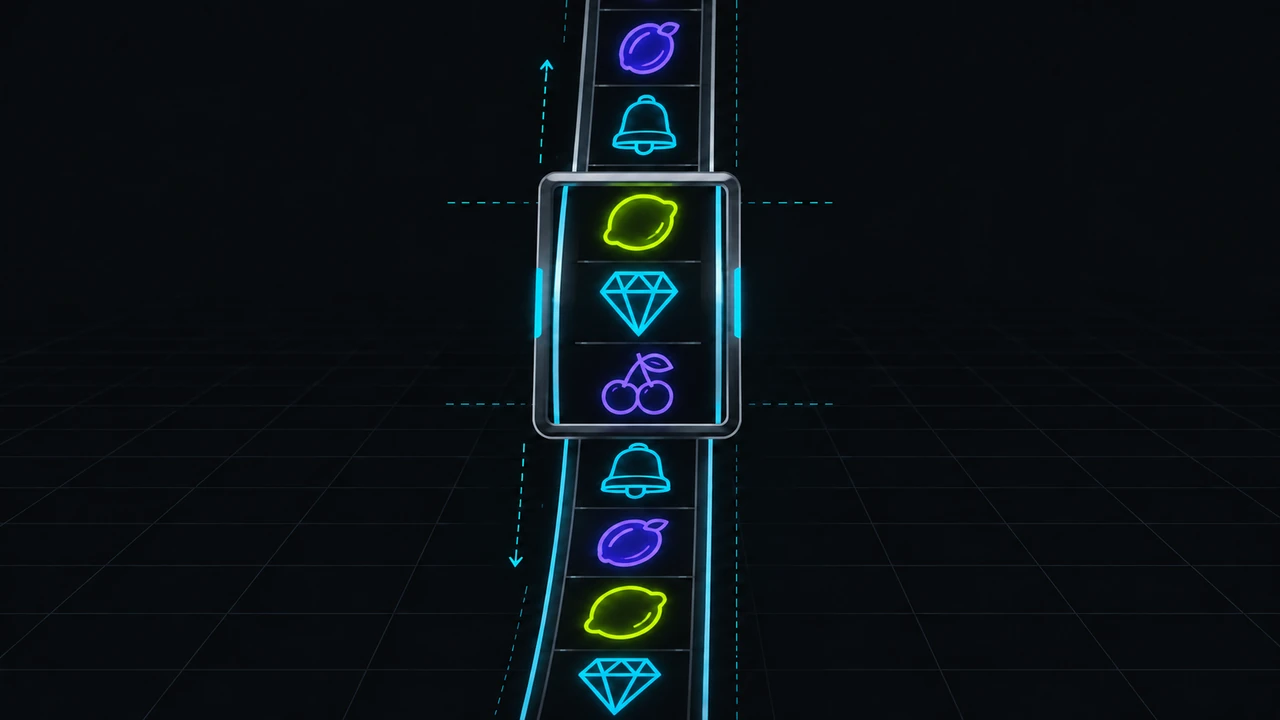
Where the multiplier comes from: travel, not a meter
San Quentin's multipliers are not held on a meter or printed on a symbol. They come from distance moved. xNudge, the mechanic Nolimit City attaches to its wild, works as the provider describes it: the wild lands stacked and partly off the visible reel, nudges until it is fully in view, and each step adds one to a win multiplier applying to wins the wild joins.
The clause most readers skim is the last one. The multiplier is earned by travel, so a wild landing already fully visible has nudged nowhere and adds nothing on that count, while one landing almost entirely off-screen has further to haul itself. Two spins can end showing the same wild in the same place and pay differently; the explanation is where each started.
How several nudge multipliers combine is not a thing to guess at, because the answers are not close. Take three wilds that earned 3, 4 and 5: added, that is 12×; multiplied, 3 × 4 × 5 = 60×. On a $0.50 stake against a win of 40 times stake, that is $240 against $1,200 off an identical board. The rules state which convention applies; the animation does not.
Carrying the answer between titles is the standard error, because the combination rule is a per-title decision rather than a property of the mechanic. When a round confuses you, separate the two inputs: how wide the board was when the win was counted, and what multiplier the wilds carried into it. From round history, those two numbers account for most results.
// sponsored · Safe Casino · 18+
+500% + 120 free spins
Safe Casino welcome offer. Check the qualifying deposit and wagering conditions before you claim.
Enhancer Cells: the trigger and the payload
Enhancer Cells decide whether anything happens at all, and they are the part least often described accurately. A cell is not a symbol you can win with. It is a slot attached to a reel that sits dormant until the game activates it, and on activation it reveals something onto that reel.
Hold it as a trigger and a payload. The trigger is whatever the rules say activates a cell; the payload is what it reveals, and the panel lists the reveal set — ordinary symbols, expansion symbols and wilds among them. They are separate events, which is why some spins show an altered board and no win, while others pay something the pre-reveal symbols cannot explain.
That gives a diagnostic worth more than most strategy writing. A board merely taller than usual is expansion at work. A board holding a symbol type the base game does not otherwise put there is a cell having fired. A board that is both is the compound event this game is built to produce occasionally.
It also sets a realistic expectation. Because the cells are the gate, most base spins resolve at or near the resting layout, paying little or nothing — the designed shape of a top-of-scale volatility game, not a cold streak or a build swapped out underneath you. Because cells attach to specific reels, where a reveal can appear is constrained by design.
Figures differ between builds and lobbies. Read the live game's information panel before you rely on any of them.
Play here →Lockdown Spins: what persists and what resets
Lockdown Spins is the free-spin feature, entered on scatters, with the combination deciding which version of the round you get. Nolimit City's convention is to present the versions as separate named features. They are better understood as rungs of one ladder, because the names are not what separates them.
Persistence is. On the lower entry the board largely rebuilds itself each spin, so a wide board on spin two says nothing about spin three. Higher up, effects are held — expansions, wilds or accumulated multipliers carry forward rather than being re-rolled from nothing — and spin count stops determining the size of the round. Which effects stick on which rung is stated in the rules.
This is why ranking rounds by spin count misleads. A short round where the board stays wide and a multiplier accumulates is not comparable to a longer round where neither happens; they are different features wearing similar labels. The game names which one you entered as it starts, and round history keeps the record.
The common failure mode produces complaints rather than mistakes: somebody watches a clip of the top rung, triggers the lowest rung, sees a round behaving nothing like it and concludes the operator swapped the build. That rung was never designed to accumulate. On several titles in this family a scatter arriving mid-round promotes it, changing the rules partway through rather than adding spins at the end — whether this one does is a panel question.

Why the maximum win cap matters most on this title
Every modern pokie publishes a maximum win as a multiple of stake, and on most games it is a line nobody meets. Here it is the most important number in the panel after the return figure, because this game is engineered to compound two independent effects against each other.
Expansion multiplies the ways count; nudge multipliers multiply the win those ways produce. A round that widens the board and then applies a large multiplier to it is not adding two good outcomes together, it is multiplying them, and multiplicative structures are what generate the extreme tail this title is known for. The cap is the ceiling on that tail, and the maths is computed with it in place.
Work it through with a hypothetical cap, because this page will not print a figure it has not read in your build. Suppose the panel shows 20,000 times stake. At $0.40 a spin that ceiling is 0.40 × 20,000 = $8,000. If a round then assembles a result the paytable would otherwise settle at 26,000 times stake, or $10,400, you are paid $8,000. The remaining 6,000 times stake is truncated — not carried to the next spin, not held over, not paid later.
Two sub-rules decide how often the ceiling bites. Whether the cap applies per spin or per round: a per-spin cap on a feature that keeps running is a different instrument from a per-round cap that ends everything. And whether the spins you had left are played out or forfeited once it is reached. Titles in this catalogue answer both differently.
Because the published return is computed with the cap in place, the cap sits inside the percentage you read, so two builds with different caps are not the same bet even when the return figures match. Treat cap and return as a pair. None of this is a reason to chase the ceiling and nothing above changes the designed return; the cap is simply the most the machine can do.
// sponsored · WinCrown · 18+
+500% + 120 free spins
WinCrown welcome offer. Read the current promotion terms, eligibility and withdrawal conditions.
RTP versions: the figure belongs to your operator's build
The query that brings most readers here wants one percentage, and the structural answer is that there is not one. Nolimit City ships its titles in more than one return configuration, the operator selects one at integration, and the artwork, symbol set, features and name are identical across builds. Two lobbies can both run this title honestly at materially different returns.
The figure is a property of the integration rather than of the game, which makes any percentage on a review page a snapshot of one build in one lobby on one day. That is why none appears here. Refusing to print one is this network's house style: a number that cannot be kept true is worth less than a pointer to where the true number lives.
It lives in the information panel inside the game frame, reached through a menu in the loaded game rather than from the casino's help centre. Four lines are worth reading before a first spin: the loaded base-game return, the return on each purchase option, the volatility rating, and the maximum win multiple with its per-spin or per-round rule.
The volatility rating deserves its own sentence, and the panel's own wording is the only one worth quoting, because providers do not all use the same scale or the same labels. Where a game is rated towards the top of its provider's scale, a mean return describes the long run of a machine rather than a session; a high return figure and a brutal distribution coexist comfortably, and neither tells you anything about the next hour. The same game at two brands can also differ on the cap and on which purchase options are enabled, none of it visible from outside the game frame.
The purchase menu is a price list of different features
Where feature purchases are enabled, this title lists more than one option at different prices, and the list is not a quality scale. Each option is an entry point to a particular version of the feature, so the cheapest typically opens the rung with the least persistence — the rung whose outcomes look least like the clips that make people want to buy.
Each option also carries its own stated return, published beside it in the same panel as the base game's. The moment you click, that figure governs your session and the base-game percentage becomes irrelevant to you. The standard error is reading the headline at the top of the panel, then buying something whose own figure sits lower down the same screen.
A decision rule before any purchase: read the return line on the specific option you are about to click; confirm the charge in your own account currency rather than the game's display currency; and confirm which version of the feature it opens. If the panel will not answer one of the three, stop. Buying does not raise the ceiling either — the cap applies to a purchased round exactly as it applies to a triggered one.
One boundary is worth naming before you reach for a purchase with promotional money in the balance. How a charge priced at a multiple of base stake is treated under an operator's terms is a question about those terms, not about this game's maths, and it is answered brand by brand in the terms themselves rather than anywhere in the game frame. Whether an operator's bonus is worth taking is pokiesledger.com's subject (operator shortlists and bonus offers), and what happens to a withdrawal afterwards is pokiescashout.com's (payments, withdrawals, KYC). This page stops at the panel.
Reading the information panel, in order
The panel is the document of record, and reading it in a fixed order takes about ninety seconds. Work from structure to money, because the earlier answers change what the later ones mean.
First, the resting layout and the ways count at rest. Second, what expansion does on this build: which reels it can affect, and whether an expanded reel persists into the next spin. Third, the nudge rule — one step, one added to the multiplier, and critically whether several wilds' multipliers add or multiply. Fourth, the Enhancer Cells: what activates one, and everything it can reveal.
Fifth, feature entry: which scatter combinations open which version of Lockdown Spins, the spin count for each, and what persists on each. Sixth, retrigger and mid-round promotion. Seventh, the loaded return plus the separate return on every purchase option. Eighth, the maximum win multiple, its per-spin or per-round rule, and what becomes of remaining spins when it is reached.
Three of those eight — the nudge combination rule, the purchase-option returns and the cap's termination rule — differ most often between builds and between sibling titles, so they are the three to re-read in an unfamiliar lobby rather than assume. A screenshot of the panel before the first spin is the only record you will hold of what you were shown, which matters more than usual on offshore software.
On a phone, and where this page stops
This title is harder to read on a phone than most pokies, and the cause is the mechanic rather than the port. A board that begins asymmetric can finish several positions taller on more than one reel, and the renderer responds by shrinking everything. The symbols that end up smallest are the ones doing the work.
So read the breakdown instead of the board: round history states what was counted and at what multiplier. Two interface notes belong to this studio's frame rather than to pokies generally. The information panel is reached through a menu inside the game, so locate it once per operator. And the purchase menu sits in the same region, putting a control that costs a multiple of your stake beside the one explaining what it costs, on a touchscreen.
Availability is not something this page will assert: catalogues change without notice and provider agreements differ by market, so a tile in last week's screenshot proves nothing about a lobby today. If you want somewhere to run the panel check above, Safe Casino and WinCrown both expose a provider filter in their lobbies, and a Nolimit City filter on the live site is how you would see what either lists at the moment you look — a navigational note, not a claim about either catalogue. Both are offshore rather than Australian-authorised: the ACMA's position is that online casino services cannot lawfully be provided to people in Australia.
What is stable here is the mechanical description — an asymmetric board that begins at its smallest, xWays expanding a reel and copying a symbol across it, nudge multipliers earned one per step of travel, Enhancer Cells gating the machine, Lockdown Spins differing by what persists, and a cap that truncates rather than defers. Nothing numeric appears: no loaded return, no purchase prices or their returns, no maximum-win multiple, no volatility figure, no cap termination rule. Those need the panel in the lobby you are sitting in, on the day.
Nor is any of this a recommendation to play. A machine built to compound makes every near-miss feel like evidence the structure was about to work, and that feeling is a product of the design rather than information about the next spin. No reading habit and no purchase option changes the designed return. Set a spending limit and a time limit before opening a lobby, keep both clear of money needed for anything else, and stop if continuing has become about recovering what the last round took. Sponsored links on this site can earn the publisher a commission.
Questions people actually ask
What is the RTP of San Quentin xWays?
There is no single figure. Nolimit City ships the title in more than one return configuration and the operator chooses one when it integrates the game, so two lobbies can both run it honestly at different returns. Each purchase option carries its own separately stated figure as well. The one that applies to you is in the game's information panel, inside the game frame, in the lobby you are playing in today.
What does an xWays symbol actually do?
It reveals a number of matching symbols and expands the height of the reel it lands on, so a reel that held one position holds several showing the same symbol. That raises the ways count, which is a product across the reels rather than a sum, so growth on one reel multiplies the total. It carries no multiplier of its own — that is the nudge wild's job, and the two are routinely confused.
Where does the multiplier in San Quentin come from?
From the xNudge wild's travel. The wild lands partly off the reel and nudges until it is fully visible, and the provider states that each step adds one to a win multiplier applying to wins the wild joins. A wild that lands already fully in view has nudged nowhere and adds nothing on that count, which is why two apparently identical boards can pay very differently.
Do several nudge multipliers add or multiply?
That is a per-title rule stated in the panel, and the two answers are far apart: wilds earning 3, 4 and 5 give either 12x when added or 60x when multiplied. Nothing on screen distinguishes the conventions while the animation runs, and the answer read in another Nolimit City title establishes nothing about this one. Read the line in the build you are playing.
Why does the max win cap matter so much on this game?
Because the game multiplies two independent effects — a widened board, and a nudge multiplier applied to it — which is the structure that produces an extreme tail. The cap is the ceiling placed on that tail, and the published return is computed with it already in place, so two builds with different caps are not the same bet even if their return figures match.
What happens if a round hits the maximum win?
The result is truncated at the ceiling and paid. Anything the arithmetic would otherwise have settled above it is not carried to a later spin or held over to another round. Two sub-rules decide how often that bites: whether the cap applies per spin or per round, and whether remaining free spins are played out or forfeited. Titles in this catalogue answer both differently, so read the loaded game's rules.
Is the most expensive bonus buy better value?
Not automatically, and the question is slightly misframed. The options open structurally different versions of the feature rather than more of the same one, and each has its own stated return printed beside it. Read that line rather than the headline at the top of the panel, confirm the charge in your account currency, and note that buying does not raise the cap.
Can I play San Quentin xWays at an Australian-licensed casino?
No. The ACMA's position is that online casino services cannot lawfully be provided to people in Australia, so every online lobby reachable from this page is offshore and outside Australian consumer protection, whatever currency it displays. Whether a particular brand carries the title today is readable only from that lobby's provider filter on the day.
// next step
A paytable makes more sense with the game open in front of you.
View current offer