
- Studio
- Sydney, launched 2011
- Owner
- Evolution group, agreed 2021
- Own engines
- Megaways, Megaclusters, Megaquads
- Attribution check
- Provider line, rules screen
- Australian licence
- None exists for this sector
A Sydney studio that sells engines as well as games
Big Time Gaming launched in 2011 in Sydney under Nik Robinson, and it has never operated like a content factory. The catalogue is small beside the studios it competes with, and its commercial weight is out of all proportion to that catalogue, because the studio earns twice from the same engineering: once when it releases a pokie, and again when another studio pays to put the same reel engine inside a different game.
That second revenue line is why you have heard of this studio at all. Megaways is not a public technique anybody may copy; it is licensed intellectual property, and the licensing programme turned a small Australian developer into a brand stamped on games made by far larger companies. When Evolution announced in April 2021 that it had agreed to acquire the studio, that announcement described the mechanic as incorporated in over two hundred games from multiple providers — a figure describing the licensing programme on that date, not the studio's own output. Keeping those two apart is the most useful habit this page can hand you.
Evolution also owns NetEnt and Red Tiger, so the studio now sits alongside two other well-known pokies suppliers. Group ownership changes distribution and platform integration. It does not change the mathematics of a build certified before the deal, and it is not evidence about return, volatility or payout speed.
There is an awkwardness in writing about this studio for an Australian audience. The engine that reshaped online pokies globally was drawn up in Sydney by people who grew up with venue machines, and online casino services cannot lawfully be provided to people in Australia. A studio's postcode is not a licence and it is not permission. Australian-made makes the games feel familiar and does nothing to the standing of the lobby you found them in.


18+ · Bonus conditions
Offer information supplied: 2026-10-05.

18+ · Bonus conditions
Offer information supplied: 2026-10-05.
Telling a Big Time Gaming build from a licensed one
Because the engine is licensed, the studio name and the mechanic name have come apart, and nearly every mistake readers make about this studio begins there. A filter labelled Megaways returns a list dominated by other developers. A filter labelled Big Time Gaming is only as good as the metadata the lobby was handed, and licensee titles get filed under the licensor often enough that the filter is a hint rather than an answer.
The check that settles it is one screen. Open the game, open its information or rules screen, and go to the last page, below the paytable and the feature rules. Suppliers put the provider and copyright line there, and it names the company that built the build you have loaded. Then look for a second line: a trademark acknowledgement stating that Megaways is used under licence. That difference is the whole trick — an acknowledgement proves a licence exists, which means somebody other than the owner built the game, and a Big Time Gaming title has no licence to itself to acknowledge.
Three weaker signals are quicker. The loading splash usually carries the developer's logo rather than the engine's. The engine name in a title is merchandising, so a licensee leans on the Megaways suffix harder than the owner needs to. And a rules screen's layout is a house habit that stops at the licence boundary.
The decision rule: the provider line in the rules screen of the build in front of you beats the lobby tile, the filter, the provider tag in the game list and any review page, this one included. Where they disagree the rules screen wins, because it is written by the software you are about to stake money in and the others by marketing databases. A studio is a reliable proxy for design conventions and for how thoroughly its features are documented. It is not a proxy for return, and the section after next explains why not.
The three engines the studio owns
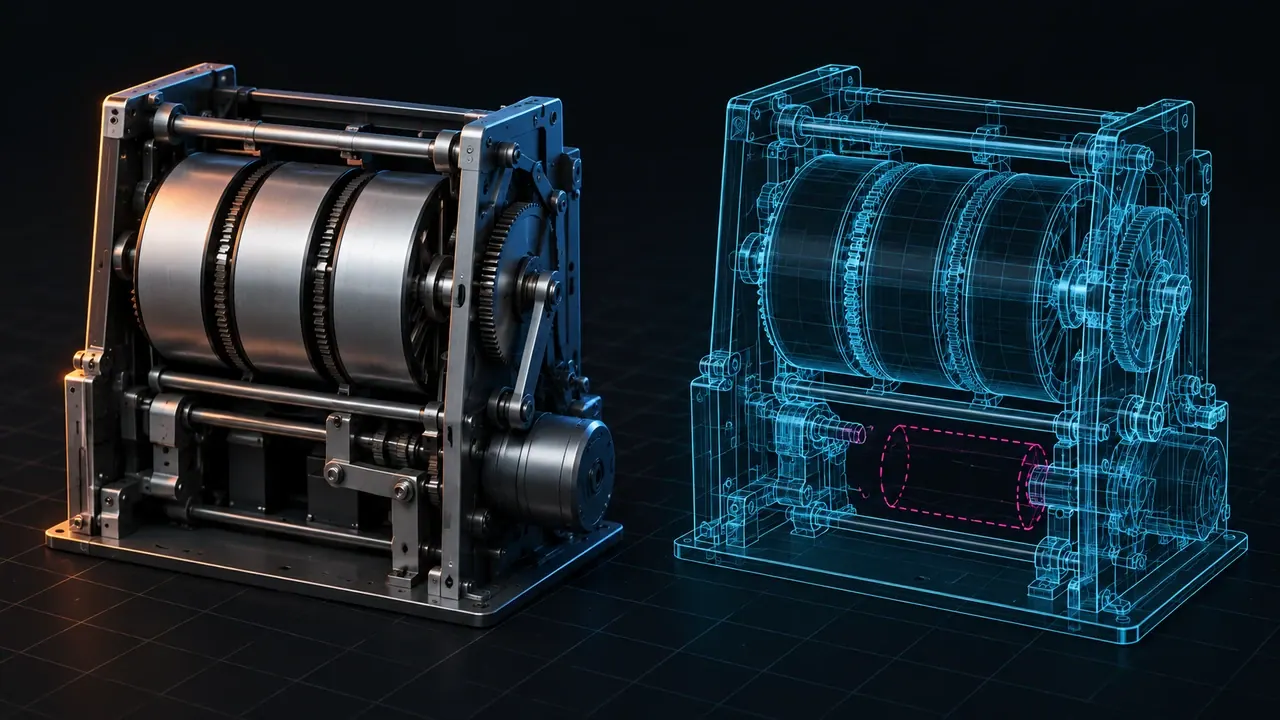
Big Time Gaming has invented more than one engine, and knowing which is which turns a wall of near-identical thumbnails into something you can navigate.
Megaways varies the number of symbols standing on each reel from spin to spin, so the combination count is redrawn every spin. It is the licensed one, it is everywhere, and it has a page of its own on this site; the job here is only to establish that the studio owns it rather than merely uses it.
Megaclusters is the studio's cluster-pay engine, introduced in its Star Clusters release, where winning symbols split into smaller symbols and the grid subdivides as a sequence runs. It was licensed out as well — Relax Gaming announced an exclusive licence for it, which is the only reason Megaclusters titles exist under another studio's name. Who holds rights now is not something this page tracks; the licence holder publishes its own licensee list.
Megaquads runs four reel sets at once, each a four-by-four grid, with the sets interacting rather than spinning independently. Four reels of four symbols give two hundred and fifty-six combinations per set, which is arithmetic read off the grid rather than a figure anyone needs to source. It never spread the way Megaways did.
What an engine badge genuinely tells you is the shape of the distribution: where in a round the return is concentrated, and whether the drama sits in reel geometry, symbol splitting or parallel grids. What it does not tell you is the size of any number attached to it. A title carrying no engine suffix is not a lesser game; it is a game the studio did not need to badge.
// sponsored · Safe Casino · 18+
+500% + 120 free spins
Safe Casino welcome offer. Check the qualifying deposit and wagering conditions before you claim.
Words that are licensed, and words that only look it
Owning a trademark creates a second problem for the owner and a third one for you. Because Megaways is a protected name, a studio that wants the same visual promise without paying for it builds something adjacent and calls it something adjacent: a suffix implying reels of changing height, a strapline about ways counted in the tens of thousands, a thumbnail in the same tall proportions. None of that is an infringement and none of it is the engine.
So an engine-sounding suffix is doing one of three jobs. It is the owner using its own name. It is a licensee paying to use it, which the acknowledgement line will say. Or it is a different name chosen to sit beside the famous one in an alphabetical list, with no relationship to this studio whatsoever. The first two are separated by the rules screen; the third by reading the title properly, which sounds trivial until you are scrolling a lobby grid on a phone.
The consequence is about expectations rather than legality. A look-alike can be perfectly good, tuned by whoever built it to their own conventions and feature rules. Carrying across what you learned about how a Megaways round builds — when a tumble sequence usually runs out, what the feature does with the reel heights it inherited — produces confident, wrong predictions. Treat the adjacent name as a new machine and read its rules screen from the top.
Figures differ between builds and lobbies. Read the live game's information panel before you rely on any of them.
Play here →Where a return figure stops being portable
Two separate questions get collapsed into one whenever return comes up: what the studio built, and what the operator loaded. This site covers the second at length elsewhere, so here is the part belonging only to a studio page. For this studio, the licence boundary is also a boundary for every number you have written down.
A return figure read in a licensee's Megaways game tells you nothing about a Big Time Gaming Megaways game, and the reverse holds just as firmly. Different studio, different paytable, different symbol weights, different feature design — and the same reel engine underneath, which is exactly why the figures look comparable and are not.
Which is why a note about one of these games needs a field a note about an in-house studio's game does not: the provider line, copied from the rules screen, beside the exact title and the date. Without it the note is worthless in a month, because you will not remember whether you read the owner's build or a licensee's, and the title will not tell you.
What is a studio-level reputation worth, then? A house style — how much of the designed return this studio tends to park inside the feature rather than the base game, how hard it caps, how thoroughly it documents its own feature rules. That is a usable prior for deciding whether a catalogue deserves your time. It is not a figure, and a page that converts a house style into a percentage on your behalf has stopped describing and started guessing.

Whose paperwork covers which build
Certification is confusing everywhere, and the licensing programme makes it worse here. A test house certificate attaches to one game build: the random number generator and the mathematics as submitted, on the date submitted, by the company that submitted it. That last clause is what the engine complicates. A certificate held by a licensee covers the licensee's game, not the engine as the owner implements it; and a certificate held by Big Time Gaming does not travel forward into every game that licensed the mechanic. The engine is shared; the approvals are not.
A supplier licence is a different document — a regulator's permission for a studio to supply operators in that jurisdiction, business to business, saying nothing about any player. An operator licence is the third thing, and the only one of the three bearing on whether a deposit is protected.
Which makes a studio logo in an operator's footer the weakest of the three signals and the one most often presented as the strongest. Here it is weaker than usual, because an operator can display the Megaways name on the strength of carrying licensees' games and no direct relationship with Sydney at all. At best it indicates some supply relationship upstream; at worst it is an image file. It is categorically not evidence of Australian authorisation, because there is no Australian authorisation to hold for online casino services.
Where a certificate is genuinely available, read the issuer, the exact title, the build identifier, the date and the stated scope — then check whether the company named on it is the company named in that game's provider line. A badge graphic with no document behind it is not a certificate. If a round faults, escalation runs to the operator and then its licensor, not the studio, which is why the round history entry rather than a screenshot of the reels is the record worth keeping.
// sponsored · WinCrown · 18+
+500% + 120 free spins
WinCrown welcome offer. Read the current promotion terms, eligibility and withdrawal conditions.
Reading the catalogue: originals, engine debuts and licensed IP
The output sorts into three groups that behave differently as decisions rather than as entertainment. Originals are the studio's own themes, and they are where the engines debut. If you want to see what an engine was designed to do before licensees reinterpreted it, this is the group to read.
Follow-ups need care here, because a sequel from this studio can mean two things. Sometimes a name returns on the same engine with a reworked paytable; sometimes it returns on a different engine altogether, which makes it a new machine wearing a familiar jacket. The engine is named in the title or the rules screen; theme continuity is asserted by the art, and the art is much the less reliable of the two. Establish which engine you are holding, then read the volatility rating and the payout cap in the newer title's own panel.
Licensed third-party IP — television, music and film brands — is the third group, and a famous brand reliably predicts the audio and the naming of the features and nothing beyond. A licence fee is a cost to the studio, not a parameter of the mathematics, and inferring a lower return from an expensive brand is reasoning about a budget you cannot see.
One house habit is worth learning by sight. Where one of this studio's titles sells entry to its feature, the studio brands that purchase rather than leaving it a generic button, which makes the label a quick way to recognise an owner-built title on a shelf full of licensees. What the label does not do is fix the price, so read the confirmation amount in your account currency at the moment you commit.
Why the studio is in one lobby and not the next
Distribution is negotiated per operator and usually arrives through an aggregator rather than directly. The engine travels much further than the studio does: a lobby can be thick with Megaways-branded titles and hold none of this studio's own builds. And the studio can be present while one specific title is absent, because licensed-IP rights are negotiated title by title and territory by territory. A missing game is far more often a rights boundary than a fault.
If you are working through Safe Casino or WinCrown, do there what you would do anywhere: run the provider-line check on whatever their Megaways search returns, because a provider tag is not an attribution, and no page written before you opened the lobby — including this one — can tell you which builds are live inside it.
If the studio name returns nothing in a lobby search, search the engine names instead and then run the attribution check on what comes back, because provider tags are incomplete more often than they are wrong. And if the attribution check cannot be completed at all — no provider line, no copyright notice, a rules screen that will not open — treat that as information about the lobby rather than a reason to keep going.
What this page could not verify
No per-title figures appear here. Return configurations, payout caps, feature frequencies and purchase prices are properties of a build in a lobby on a day, and this studio ships licensed engines into other studios' games, which multiplies the ways a copied figure can be wrong.
Licensing arrangements change. The scale of the programme quoted above, and the Megaclusters exclusivity, are dated statements from when they were announced rather than a current roster. The licence holder publishes its own licensee list, which is the only version worth citing.
The corporate facts are taken from Evolution's April 2021 acquisition announcement. Which group entity supplies which market today, and how the studio is structured after integration, is not something this page could confirm.
No operator's catalogue is described here, no payment method or limit is attributed to anyone, and no title is recommended. The purpose is narrower: to stop a lobby of identically badged games being interchangeable, and to put the provider line in the rules screen ahead of every other source, this page included.

Questions people actually ask
Is Big Time Gaming an Australian company?
It launched in Sydney in 2011 under Nik Robinson and is Australian in origin. That is a fact about where the games were designed, not a licence: online casino services cannot lawfully be provided to people in Australia, and an Australian-founded studio does not change the standing of an offshore lobby carrying its games.
Does Big Time Gaming make every Megaways pokie?
No, and this is the most common misunderstanding about the studio. Megaways is licensed intellectual property used by many other developers, so most Megaways titles in a lobby were built by someone else. Evolution's April 2021 announcement described the mechanic as incorporated in over two hundred games from multiple providers.
Who owns Big Time Gaming now?
Evolution announced in April 2021 that it had agreed to acquire the studio, placing it in the same group as NetEnt and Red Tiger. Ownership affects distribution and integration, not the mathematics of an already-certified build, so do not read the corporate chart as information about return or payout speed.
How do I tell which studio actually built the game I opened?
Open the rules or information screen and read the last page. The provider and copyright line there names the company that built that specific build. A separate line acknowledging Megaways as a trademark used under licence means the game is a licensee's rather than the owner's. That line beats the lobby tile, the filter and any review page.
What are Megaclusters and Megaquads?
Two further engines the studio invented. Megaclusters is its cluster-pay format, introduced in Star Clusters, where winning symbols split and the grid subdivides as a sequence runs; Relax Gaming announced an exclusive licence for it, and this page does not track who holds rights now. Megaquads runs four interacting four-by-four reel sets, so each set draws from 256 combinations.
Is a sequel to one of its games the same machine?
Not necessarily, and this studio is a particular case. A follow-up here sometimes returns on the same engine with a reworked paytable and sometimes arrives on a different engine altogether, which makes it a new machine in familiar art. The engine is named in the title or the rules screen, so read the volatility rating and the cap in the newer title's own panel rather than carrying them over.
A title's name suggests changing reels but it is not Megaways. How can I tell?
Because the name is a trademark, studios wanting the same visual promise without a licence pick an adjacent name. Open the rules screen: an owner-built title names Big Time Gaming in the provider line, a licensee carries a line acknowledging Megaways as a trademark used under licence, and a look-alike carries neither. The third case is a different engine tuned by different people, so read its rules from the top.
// next step
A paytable makes more sense with the game open in front of you.
View current offer