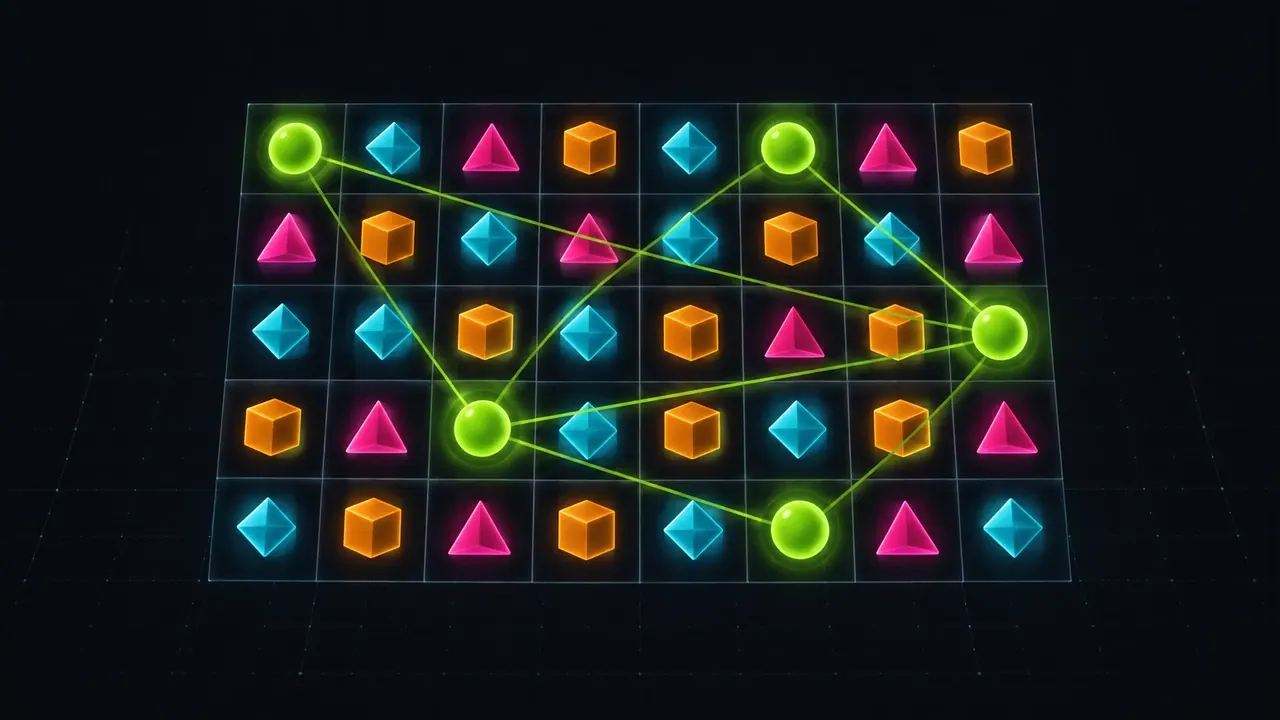
- Win type
- Connected groups
- Adjacency
- Side to side, not corners
- Minimum size
- Set per title
- Paylines
- None
What actually counts as a cluster
A cluster is a set of identical symbols occupying positions that touch edge to edge. Touching means sharing a side. Each position has at most four neighbours — above, below, left, right — and corner contact is normally excluded. That one sentence is the entire win condition, and nearly every misread of a cluster board comes from not applying it literally.
Two shapes make the rule concrete. Five identical symbols in a plus — a centre with a neighbour on each side — form one connected cluster, because every member can be reached from every other by side-to-side steps. Five identical symbols running corner to corner down the grid form nothing at all, because consecutive members touch only at their corners. Both arrangements show the same symbol the same number of times. One is a win and one is not.
The shape itself carries no weight. An L, a ring, a staircase padded into connectivity, a snake wandering across four columns — all pay exactly as a solid block of the same member count would, because the rule counts membership and connectivity and nothing else. There is no orientation bonus and no preferred position on the grid.
The minimum size that qualifies is set per title and stated in the paytable. It is not a property of the mechanic, it is not constant across a studio's catalogue, and it is the first thing to read rather than assume.


18+ · Bonus conditions
Offer information supplied: 2026-10-05.


18+ · Bonus conditions
Offer information supplied: 2026-10-05.
The leftmost rule is gone
Line games and ways games both require a win to start on the leftmost reel and continue across consecutive reels. Cluster pays discards that, and the consequences run further than they first appear.
A qualifying group can sit entirely in the right-hand columns, or float in the middle of the grid with nothing of interest around it. A matching symbol in the first column contributes nothing unless it is connected to the group. Position carries no privilege, which means the habit of scanning left to right for the start of a win is not merely unnecessary — it actively hides wins sitting elsewhere.
Near-miss reading changes with it. On a line game, a symbol landing on reels one, two and four reads as a near miss on a five-of-a-kind. On a cluster grid, the same symbol spread across three columns with a gap in the middle is not one cluster short of anything; it is two separate groups, each judged against the minimum on its own. Whether a later refill joins them is a question about the gap, not about the total count on screen.
The grid is usually larger than a line game's and frequently close to square. Read its dimensions, because the number of positions is the hard ceiling on how large any cluster can be, and that ceiling is what the top paytable band is written against.
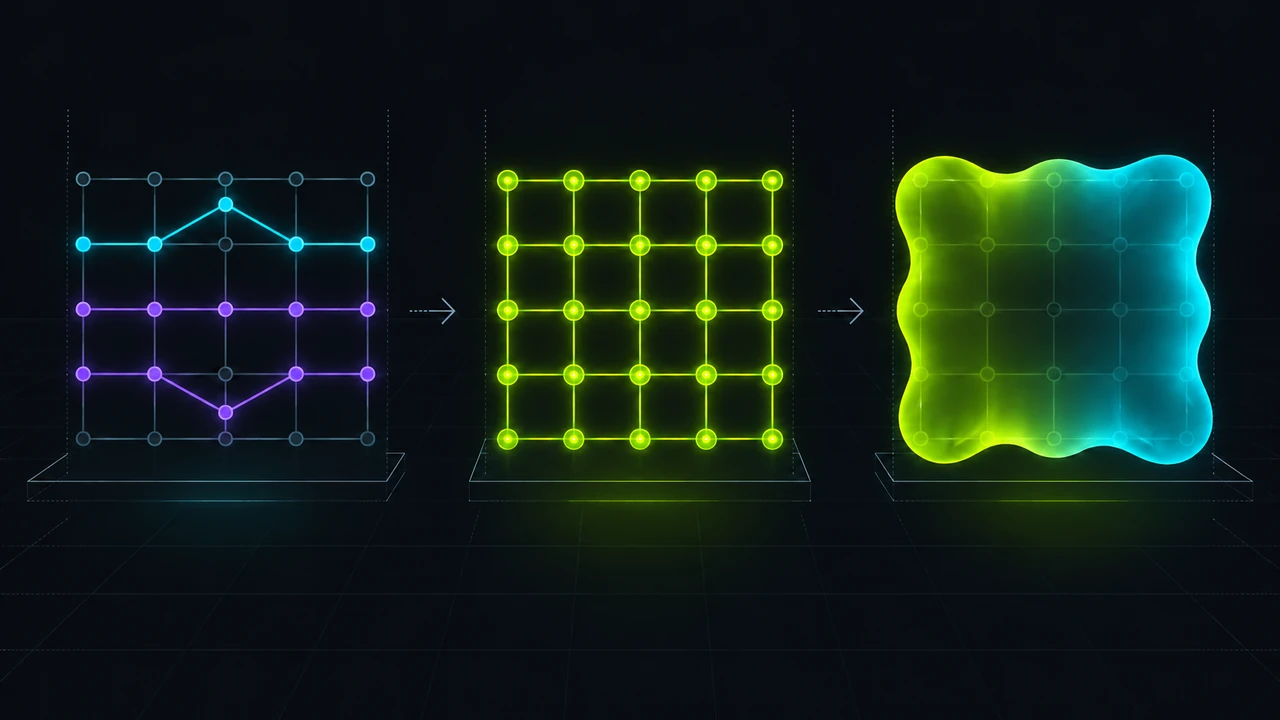
How a cluster paytable is laid out
A cluster paytable is indexed by group size, not by symbol count across reels. Each symbol gets a row, and the row is divided into size bands: a range of member counts, and the prize that range pays. Read it as a step function rather than a slope. Adding one member to an existing cluster changes nothing at all until the addition crosses a band edge, at which point the prize jumps.
That structure produces the single most consequential event on a cluster board: a refill dropping one more matching symbol into a group sitting at the top of its band. One position, and the same group pays a materially different prize. Nowhere else in the game does a single symbol carry that much weight, and it is worth knowing which band edges are near when you are reading round history to understand an amount.
Two further things the row needs to tell you. Whether the top band is open-ended — written as a count "or more" — and what the largest cluster the grid can physically hold actually is. A top band quoted against a count the grid cannot produce is a band you will never reach. Each qualifying cluster pays once, and the board total is the sum of every qualifying cluster present, so two separate groups of the same symbol each collect their own band's prize independently.
Where wilds exist, read whether a wild joins a cluster as a counted member or merely substitutes for the symbol without adding to its size. Those are different rules, and they produce different band outcomes from an identical board.
// sponsored · Safe Casino · 18+
+500% + 120 free spins
Safe Casino welcome offer. Check the qualifying deposit and wagering conditions before you claim.
When two groups touch
Here is the failure mode that generates most "the game paid me wrong" complaints on cluster titles, and its cause is a definition rather than a fault.
Two groups of the same symbol come to touch, usually because a refill landed a matching symbol in the gap between them. Players expecting two payouts frequently see one, and read the single amount as a missing win. The connectivity rule explains it: if any member of one group shares a side with any member of the other, they are not two clusters. They are one cluster, of the combined size, paid at whichever band that combined count falls into. The arithmetic can go either way — a combined payout at a higher band can exceed or fall short of two separate mid-band payouts, depending entirely on where the band edges sit.
The mirror-image misread is just as common. Two groups that appear to touch, but only at a corner, stay separate. The player who expects the combined band sees two smaller amounts and concludes the game failed to merge them. It did exactly what the rule says.
The diagnosis is a procedure, not a judgement. Open the round history, find the board in question, and trace a side-connected path through the members you believe formed the group. Count them. If the count falls inside a band and the amount matches that band's prize for that symbol, nothing is missing and the rule is simply not the one you assumed.
Figures differ between builds and lobbies. Read the live game's information panel before you rely on any of them.
Play here →Refills, gravity and the board you cannot see
Cluster grids nearly always clear winning symbols and refill the gaps, because a mechanic that pays for density needs a way to change density. The general behaviour of chained wins inside one paid round belongs to the tumbling reels page. What matters here is the geometry, which is particular to cluster games.
A cluster can clear a hole anywhere, including a hole in the middle of the grid with symbols above and below it. That forces a design decision no line game has to make, and implementations differ. Under a gravity model, symbols above the hole fall into it and new symbols enter from the top edge. Under in-place replacement, the hole is filled where it sits and everything around it stays put. The same winning cluster on the same board produces two different follow-up boards depending on which model the title uses.
The distinction is not trivia. If you are working out where a follow-up cluster could plausibly form, the implementation is the entire answer: gravity destroys the vertical neighbour relationships at the clear line while preserving them above it, whereas in-place replacement preserves the neighbourhood around the hole completely. The rules state which applies.
This is also why the final arrangement on screen never explains the round. Every board that paid has already been cleared. The amount displayed at the end is the sum of boards you can no longer look at, which makes round history the only honest source for reconstructing a win.

Position multipliers on a cluster grid
A large share of modern cluster titles add a per-position multiplier layer. A square on the grid acquires a multiplier value when a cluster clears over it, and that value can grow and persist. This interacts with cluster geometry in a way that has no equivalent on a line game: where you win changes what later wins are worth. The same cluster, in the same shape, pays differently depending on which squares it happens to cover.
Four questions decide how such a title behaves, and the branding on the lobby tile answers none of them. Does the multiplier apply to the cluster that created it, or only to later clusters covering that square? Do several covered squares add their values together or multiply them? Does the layer reset between refills, between paid spins, or only when the feature ends? And is the layer present in the base game at all, or exclusive to the feature?
Two cluster titles with the same grid dimensions and the same minimum cluster size are entirely different games if one wipes its multiplier layer every spin and the other carries it through a whole feature. The second concentrates return into rare rounds that happen to build a dense layer before a large cluster lands on it.
Concentration is not generosity. What it does to the spread of outcomes is the subject of the volatility guide rather than this page, and a persistent layer is a reason to read that rating more carefully, not a reason to skip it.
// sponsored · WinCrown · 18+
+500% + 120 free spins
WinCrown welcome offer. Read the current promotion terms, eligibility and withdrawal conditions.
Four ways a cluster board gets misread
Counting diagonals. The eye trained on paylines follows diagonal runs because paylines used to reward them. Unless the rules specifically say otherwise, a diagonal run of matching symbols touching only at corners is neither a cluster nor a near miss.
Applying the cluster rule to the feature trigger. Feature triggers on cluster games are usually scatter-style: a count of trigger symbols anywhere on the grid, with no connectivity requirement at all. Reading the adjacency rule onto the trigger symbol produces errors in both directions — believing you were one short when the scattered count was already met, or believing a trigger was close when those symbols were never going to need to connect.
Reading grid size as generosity. A larger grid allows larger clusters and a higher top band. It also means more positions a symbol has to occupy before the minimum is satisfied, and more places for a group to be broken by something else landing inside it. A bigger grid is a different distribution, not a looser rule.
Treating a minimum-size cluster as a win. A group at the smallest qualifying size commonly returns less than the stake that paid for the spin, and the game will mark it with the same sound and the same colour it uses for everything else. The round's net result is what you staked minus what came back, and a celebrated return of part of your stake is still a loss.
A procedure before you stake on one
Six checks, in order, in the loaded game's help panel rather than on any page about it. First, the adjacency definition — confirm in writing whether diagonals count. Second, the minimum cluster size. Third, the size bands, including whether the top band is open-ended and whether the grid can produce the count it names. Fourth, whether a wild counts as a cluster member or only substitutes. Fifth, the refill implementation, gravity or in-place. Sixth, the multiplier layer rules if one exists, and specifically where it resets.
The decision rule is narrow and useful: if the paytable does not answer the first, second and fourth of those, you cannot verify a payout you receive. A game whose win condition you cannot check is a game where you have no way to tell an ordinary outcome from a fault, and that is reason enough to play something documented instead.
Cluster titles are rarely shelved under a heading of their own. Lobbies sort by studio or by a marketing label, so the mechanic is something you identify from the grid once a title is open rather than from a filter before you open it — which is why all six checks above happen inside the loaded game and none of them in a lobby listing. The sponsored links on this site point to offshore operators, Safe Casino and WinCrown among them; what either lobby holds, and which configuration a title runs there, is readable only on the live page and in that game's own help panel. Online casino services are not licensed in Australia, and nothing here describes an operator's catalogue as it stands today.
No return figures appear on this page. Cluster titles ship at several return configurations like anything else, operators select one at integration, and a percentage copied from one lobby misdescribes another; the RTP guide explains what that figure does and does not predict. Where a specific title departs from the standard implementation described here — and some do, particularly around wild membership and multiplier resets — its own paytable is the authority and this page is not.
Questions people actually ask
What is a cluster pays pokie?
A pokie with no paylines, where a win is a group of identical symbols touching each other side to side on the grid. The number of symbols in the connected group determines the prize, read from a size band in the paytable rather than from a line win.
Do diagonal symbols count in cluster pays?
Normally no. Adjacency is usually defined as sharing a side — above, below, left or right — so symbols that meet only at a corner belong to separate groups. Individual titles can define it differently, which is why the adjacency rule is the first line of the paytable to read.
How many symbols do you need for a cluster win?
The minimum is set by the individual game and stated in its paytable. It varies between titles from the same studio, so there is no figure that holds across the mechanic. Check it in the loaded game before staking, because it also decides whether a group on screen is a win or nothing.
Why did two clusters of the same symbol only pay once?
Because they touched. If any member of one group shares a side with any member of the other, the rule treats them as a single cluster of the combined size and pays the band that count falls into. Trace a side-connected path through the members in round history and count them to confirm.
Are cluster pays pokies high volatility?
The win condition alone does not set the payout spread. Grid size, symbol weights, refill behaviour and any persistent multiplier layer all contribute, and a layer that carries through a whole feature concentrates return into rarer rounds. Use the title's own rating and the volatility guide rather than inferring from the mechanic.
Do cluster pays games always clear and refill winning symbols?
Nearly always, because a mechanic paying for density needs a way to change density. What differs is how the gaps are filled — symbols falling from above, or replacement in place — and that choice changes which follow-up clusters are possible from the same winning board.
// next step
A paytable makes more sense with the game open in front of you.
View current offer