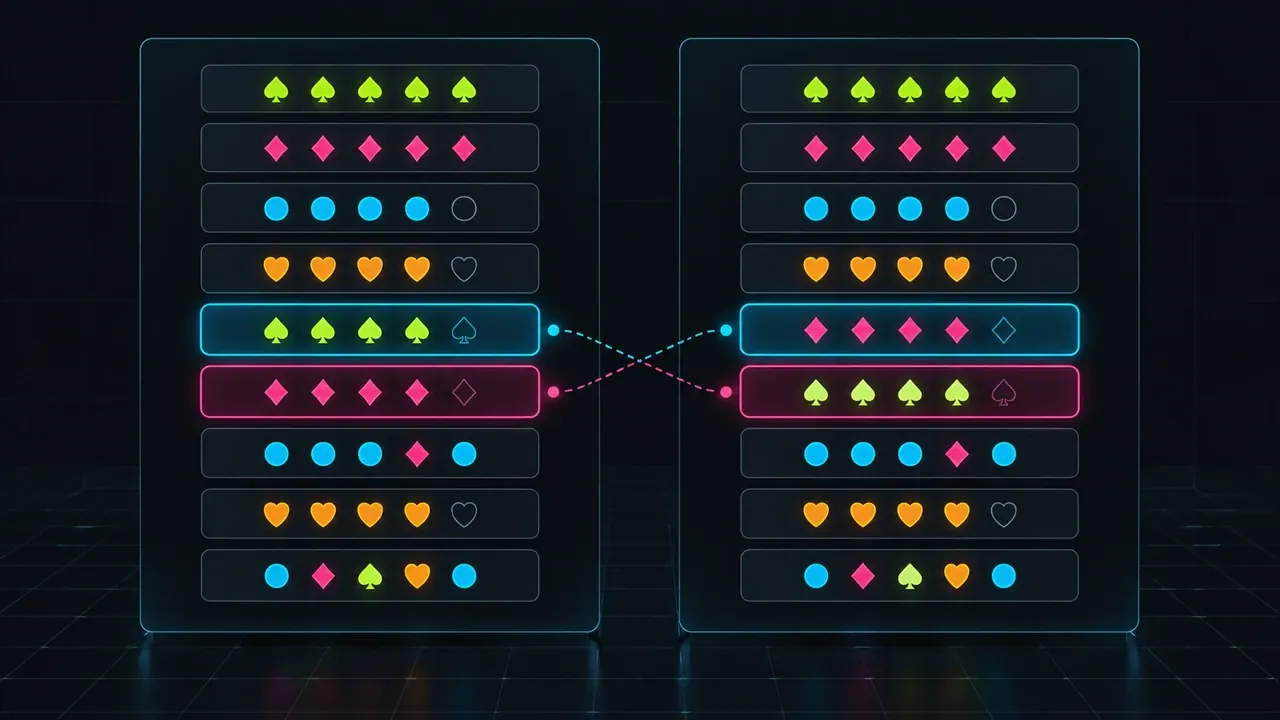
- Deck
- 52 cards, fixed odds, no symbol weighting
- Return set by
- The printed paytable plus how it is played
- The one decision
- Which dealt cards to hold before the draw
- Paytable lives in
- The game screen and information panel
- Both linked brands
- Offshore; no Australian licence
How a hand actually runs
A video poker hand is a five-card draw against a paytable, with no opponent and no dealer hand to beat. You set a coin denomination, pick how many coins to bet and press deal. Five cards appear, you mark the ones to keep, and draw replaces the rest. The final five are compared with the grid: reach its lowest paying row and you are paid the figure in the column for the coins you bet.
The deck is one deck, which is what makes the format computable. Discards are not returned to it, so replacements come from the forty-seven cards you did not hold. A build dealing from a reshuffled or multi-deck pool is a different game in the same interface; the panel says which, and most are single-deck.
The bet is in coins, not cash. A machine has a denomination and a coin count, usually one to five, and the stake is the product: five coins at five cents is a twenty-five cent hand. The paytable's columns correspond to the coin count, not the denomination, so one grid rules every denomination and only each figure's cash value moves.
Settlement is immediate and there is no bonus round to enter. Some builds add a double-up step, a random multiplier or a progressive top row, each with its own printed rules. Strip those away and every machine here is four steps: bet, deal, hold, draw. Paytables and coin ranges are set per build, so every figure below illustrates a method rather than quoting a machine you can reach.


18+ · Bonus conditions
Offer information supplied: 2026-10-05.


18+ · Bonus conditions
Offer information supplied: 2026-10-05.
Why the paytable is the game
In a pokie the mechanism is hidden and the summary published: reel weights out of sight, one return percentage printed. Video poker inverts that. The deck is standard, the rankings are standard, and the chance of completing a draw is a property of the cards rather than the build. All that varies between two machines of one name is what each hand pays.
So variants are identified by payout figures rather than titles. A Jacks or Better machine is described by the coins it pays for a full house and a flush at one coin, because those rows get trimmed most often — a nine-and-six table against an eight-and-five one. Two builds sharing a title, a logo and an identical ranking chart can sit in one lobby with different numbers there.
The arithmetic is clean. Take a build paying nine coins for a full house at one coin, so forty-five at five coins, against one paying eight, so forty. Across forty full houses the first returns 1,800 coins and the second 1,600: two hundred coins from one row, with nothing different about how the cards fell. Trim the flush row too and the subtraction runs again on a hand that arrives more often.
Those counts are illustrative. This site publishes no hand frequencies and no per-build return percentages, because studios license a title at several paytable configurations and the operator picks one. It also makes comparing lobbies by title count near-meaningless: four generous grids and twenty trimmed ones are not ranked by the count.

The coin columns and what the fifth coin buys
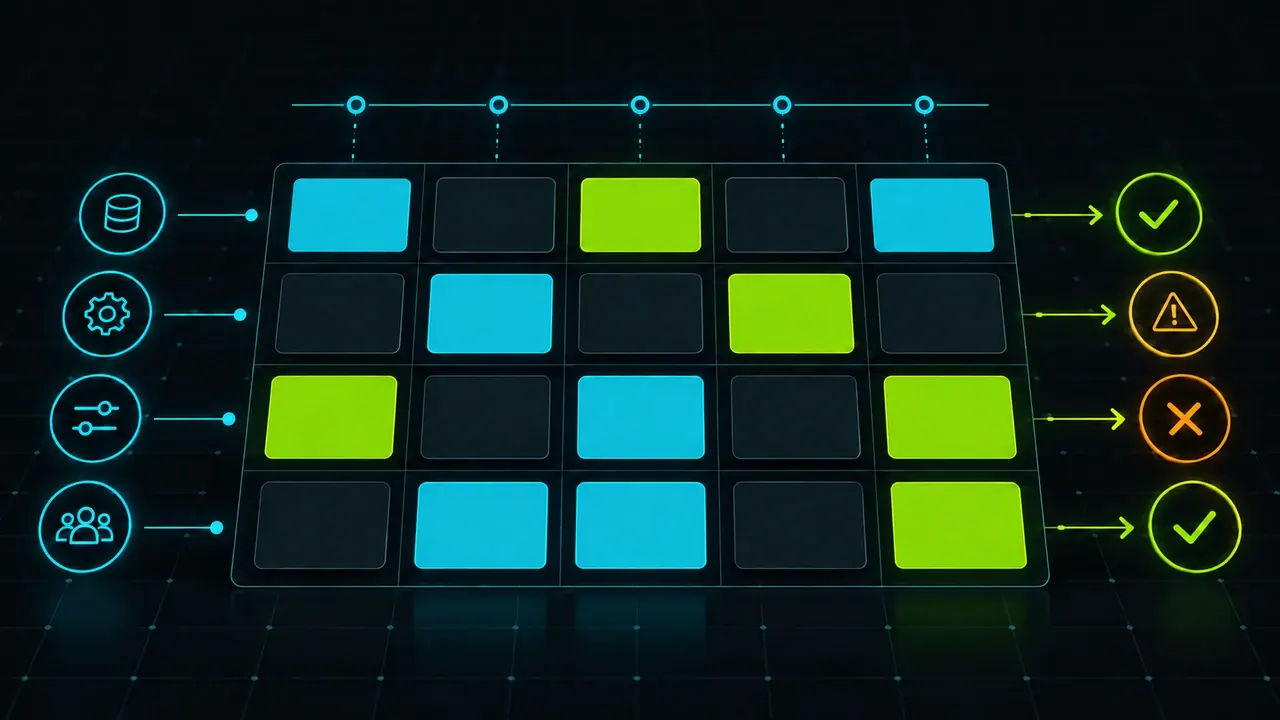
A paytable is a grid, not a list, and the columns are the part people skip. Each row is a hand, each column a coin count. Read across a row and most scale linearly — six coins at one coin, twelve at two, eighteen at three — so the column changes the cash and nothing else. The top row is where that linearity usually breaks, by design.
On many builds the royal flush row pays a flat rate per coin across the first four columns and jumps disproportionately in the fifth. Suppose a grid prints 250, 500, 750 and 1,000 coins at one to four coins, then 4,000 at five: the fifth coin has bought 3,000 of the 4,000. That is the pattern illustrated, not a quotation — read the row across all five columns on your own build.
So playing short of maximum coins on such a build lowers its return without changing anything else. That is not a strategy claim and no route to an edge; it is the full-house arithmetic applied to a column instead of a row. A reader wanting a smaller cash stake has a cleaner lever: drop the denomination and leave the coin count where the column pays proportionally.
Check two more things. Whether the top row is fixed or a progressive that climbs, which makes its value a moving number; and whether any other row breaks linearity, since a few variants disproportion a second one. None of this shows on a lobby tile, and on a handset the grid sits behind a menu inside the game frame.
// sponsored · Safe Casino · 18+
+500% + 120 free spins
Safe Casino welcome offer. Check the qualifying deposit and wagering conditions before you claim.
What the information panel states, and where it hides
Printed is not the same as prominent. On a desktop client the grid is usually a tab or a pair of arrows inside the game frame, a click from the reels. On a handset it is more often a menu item behind a hamburger or an i icon, two or three taps deep, and a few builds will only open it while no hand is in progress. Reading it before the first deal costs a few seconds; reading it after the first deal costs a hand you have already paid for.
What a panel is expected to carry is the full grid at every coin column, the hand rankings in force, the minimum paying hand, the coin denominations available, and the rules for anything bolted on top — a double-up step, a multiplier, a progressive row, an autohold. What it is not expected to carry is how often any hand arrives. Draw probabilities are a property of a 52-card deck rather than a disclosure an operator makes, which is why no panel, and nothing on this page, converts a grid into a statement about what a session will do.
Two details in a panel are worth reading twice. The first is the deck: a build that deals from multiple decks, or reshuffles the discards back in before the draw, is a different game wearing the same interface, and the panel is the only place that says so. The second is the exact wording on any progressive row, because a climbing figure and a fixed one are read differently across the coin columns — a fixed top row can be compared with another build's, a climbing one cannot be compared with anything until you know what it currently holds.
Where a panel is silent, ambiguous or contradicts the lobby tile that led you to it, the panel inside the game is the nearer authority and the operator's own game terms are the next one. Neither is this page. Nothing here describes a specific machine's grid, and the figures used in the arithmetic above were chosen to be obviously illustrative so that no reader mistakes them for a quotation from a build they can open.
Figures differ between builds and lobbies. Read the live game's information panel before you rely on any of them.
Play here →How the hold decision works
After the deal you choose which cards to keep: thirty-two possible holds, from keeping nothing to keeping everything, each leading to a different distribution of final hands once the draw comes from the remaining forty-seven. The hold is the only input a player has, and a real one: a pokie outcome is settled the moment the spin is committed, while a video poker hand is not.
What makes a hold better or worse is the paytable, not card sense. Each candidate has an expected return set by the fixed draw probabilities and the variable coins the grid pays. Change the full-house figure and two candidates can swap rank, which is why the same five cards can call for different holds on machines that look identical. This page publishes no hold charts and no hold produces an advantage.
The conflicts are structural rather than exotic. A dealt hand can hold a made paying hand and, inside it, four cards towards a much larger one, so keeping the sure thing and chasing the bigger thing are mutually exclusive. A low pair can sit alongside four to a flush. The minimum paying hand decides whether an unpaired high card is worth anything at all.
Most builds offer an autohold that pre-marks cards. Treat it as a convenience, not an authority: implementations vary, so read what the panel says it does. Two interface traps matter too — holds usually clear on the next deal but a few builds carry them forward, and draw often sits where deal sits, so the tap that draws your held cards and the tap that abandons them are one beat apart.
The variant families and what each one changes
Variants differ along three axes: the minimum paying hand, whether wild cards are in the deck, and whether specific four-of-a-kind hands are singled out for raised payouts. Everything here combines those three, and knowing which is in front of you tells you what shape the grid takes.
Jacks or Better is the baseline — no wilds, a plain deck, lowest paying hand a pair of jacks or higher. Tens or Better drops that threshold a rank, making small payouts more frequent, normally funded by trimming elsewhere. Bonus Poker, Double Bonus and Double Double Bonus keep the threshold and single out quads for raised payouts, split by rank and, in the double-double family, with a fifth-card condition — rows paid for by cuts in rows that arrive far more often.
Deuces Wild and Joker Poker put wilds in the deck, which changes more than the name suggests. With wilds in play the lowest paying hand rises — commonly to three of a kind in Deuces Wild — so the ordinary low pair pays nothing, and new categories appear: five of a kind, and a wild royal distinguished from a natural one. A wild grid cannot be compared row for row with a Jacks or Better grid.
Multi-hand is a stake structure, not a variant: one hand dealt, one hold chosen, replicated across three, five, ten, twenty-five, fifty or a hundred hands, each drawing independently. A hundred-hand build at five coins is a five-hundred-coin bet per deal. Multiplier and progressive layers sit on top of any of these and change what the grid is worth.
// sponsored · WinCrown · 18+
+500% + 120 free spins
WinCrown welcome offer. Read the current promotion terms, eligibility and withdrawal conditions.
Working out what one deal costs
Stake here is a product rather than a figure on a slider, and three factors go into it: the coin denomination, the coin count, and on a multi-hand build the hand count. Multiply the three and that is what pressing deal costs once. The arithmetic stays unremarkable until the hand count enters it, at which point a bet a player would describe as five coins is a bet of five hundred, and the build's own total-stake display is the only number worth reading before the first deal.
Speed does the rest. There is no reel animation to sit through and no bonus round to enter, so the limiting factor on how fast money moves is how fast a person can press twice — and a turbo setting removes even the short pause between the draw and the next deal. A ceiling expressed in hands therefore understates the spend by whatever the hands-per-minute rate turns out to be. A ceiling expressed in money, fixed before the first deal, does not.
Two levers lower the cost without distorting the grid. Dropping the denomination scales every figure in every column down evenly, so the machine you are playing is the same machine in smaller money. Dropping the hand count on a multi-hand build does the same thing. Dropping the coin count usually does not, because that is the column where the top row stops scaling proportionally, so the same reduction buys a worse version of the same machine rather than a smaller one.
None of that is a method for winning and none of it changes an expected outcome; it is budgeting arithmetic for a format that resolves faster than most. The practical consequence is narrow: decide the figure a single deal may cost, confirm it against the total-stake display the build shows, and treat the hand count and the denomination as the dials rather than the coin count.
How video poker differs from a pokie
The headline difference is inspectability: a pokie publishes a return percentage and keeps the mechanism out of sight, while a video poker machine publishes the mechanism. The second is that a decision exists. Every pokie outcome is settled when the spin is committed, whereas the hold is a genuine input with different expected outcomes attached. That does not make the format beatable; it makes a careless hold and an informed one non-equivalent.
Third, the shape of the distribution. A high-volatility pokie concentrates its return in rare bonus rounds with long dry stretches between. A Jacks or Better machine spreads much of its return across frequent small hands, and the top of its distribution is a single fixed row rather than an accumulating round. Bonus-family and wild variants move back towards the pokie's shape by shifting weight into rarer quads.
Fourth, the ceiling. A pokie's maximum win is normally a cap expressed as a multiple of stake, which can truncate an accumulating round mid-flight. Video poker has no such cap because it has no accumulation: the most a hand can pay is the top row at the coin count you bet, unless a progressive or multiplier layer redefines it.
Fifth, speed. A hand resolves in two presses with no animation, so hands per minute run high and turbo higher, while stake moves in coins and denominations rather than lines and bet levels. What is identical is the part people hope is different: the return is designed in, no sequence of hands changes the next one, and a printed grid makes a design visible rather than favourable.
Finding the machines in a lobby
Video poker is one of the worst-signposted categories in an online lobby, because platforms file it in at least four places. Some give it a top-level category. Some fold it into Table Games. Some put it under Other, Instant or Casual. And some leave it out of the navigation while still carrying the titles. Check all four before concluding a lobby has none.
Search is faster, and the terms that work are variant names rather than the category: jacks or better, deuces wild, joker poker, bonus poker. Searching poker alone returns three unrelated things. Casino Hold'em and its relatives are house table games played against a dealer; live or casino poker in a live-dealer area is a filmed table. Neither is video poker.
Studio attribution is thinner than in pokies. Video poker tends to arrive from a platform's own suite or a provider's table-and-card collection rather than its headline slot releases, which is why a lobby with a hundred-plus providers can still carry a short shelf — the almanac's Play'n GO page covers one studio named in both linked catalogues.
Demo mode is the quickest way to read a grid without funding anything, with one caveat: demo and real-money builds are separate integrations and can differ, paytable included. And treat a category count as a navigational signal, since lobby counts are platform tags from feeds that are not always current. A deep shelf means more to compare, not which configurations were integrated.
Where the machines sit across the two linked lobbies
Of the two operators this site links, Safe Casino is the one whose reported category list names video poker explicitly, which makes it the starting point here. Regional reviews report between 13,000 and 16,000-plus titles — slots, jackpot games, crash, bingo, video poker, roulette, blackjack, baccarat and virtual games — from more than 100 providers. Those are reported figures rather than counts made here, and they give a range rather than a number. No sub-count is published, so only the lobby's filter shows how many grids sit behind the label.
Reports place its launch around 2025 as a pure casino, with live events and a sportsbook added since — prematch markets and boosted odds, across sports including Australian rules football — though on those same accounts the sportsbook is recent and noticeably thinner than a dedicated bookmaker's. Its live area is reported at more than 1,000 tables from roughly fourteen studios, live poker among them, and live poker is a filmed table game rather than anything in this category.
WinCrown itemises its catalogue far more precisely, and the category is simply absent from the itemisation. By the operator's own statement the lobby holds 10,651 games from 113 providers, with 4,712 of them tagged Bonus Buy, 2,919 filed under jackpots and 2,010 under High Stakes, alongside Instant, Hold & Win, Megaways and curated shelves — and no draw-poker label anywhere in that list. Roughly 1,371 live games were showing on its home page, and the casino poker sitting among those is a dealt table against a dealer rather than a draw machine. The brand is new in 2026 and almost purely a casino: nothing resembling a sportsbook or a live-betting section, with sport surfacing only inside seasonal promotions.
So the hand-off is reasoned rather than a verdict. Safe Casino for this intent, because video poker is named in its reported categories and it is the larger combined regular and live catalogue of the two, and the one carrying sport. WinCrown for bonus-buy and jackpot depth, which is a catalogue observation rather than a value one. Neither is described here as safe, licensed in Australia, better value or likely to pay.
One corner of the promotional terms bears directly on this category, and the rest does not. Safe Casino's welcome package, as the operator stated it when recorded in August 2026, runs to four first deposits at 100% up to €1,000 each — up to €4,000 and 1,200 free spins in total, wagering of 40× the bonus and the free-spin winnings, a maximum bet while wagering of €5, slots usually counting 100% and live casino and table games 0%. Video poker is not itemised in that weighting at all, and because table games sit at zero in it, whether turnover on a draw machine counts towards a requirement is a question for the terms inside your own account. So is the wagering window, which sources report as 7 days in some places and 30 in others.
WinCrown's operator-stated headline of 250% up to €5,000 and 400 free spins sits beside separate cards quoting first-to-fourth deposit figures of 120%, 100%, 50% and 150%, which is reason enough to go by the specific card, the currency and the cashier's own rules rather than the headline. Its recorded promotion calendar is dynamic and almost entirely spin-denominated, which makes it worth less to a draw-poker player than to a slots player. Every figure in this paragraph and the last is reported rather than verified here, and which package holds more value is a ranking question this site leaves to Pokies Ledger.
The offshore position and what this page does not assert
No Australian authorisation stands behind either link on this page, and none is implied by what either operator does hold. The registration Safe Casino trades under is Curaçaoan. WinCrown's is a Tobique Gaming Commission licence, №0000002, held through Novatrix SRL, a company in Costa Rica. Neither of those regulators sits in Australia or answers to an Australian authority, and the ACMA's position is that online casino services cannot lawfully be provided to people in Australia — so a lobby opened from an Australian screen is an offshore lobby operating on an offshore permission, whatever badge sits in its footer.
The public reliability record is thin enough to be worth stating plainly. One figure exists for Safe Casino: 43 Trustpilot reviews averaging 2.9 out of 5 at the time of checking, among them complaints that reload bonuses went uncredited. Forty-three reviews measure very little, and the figure is quoted as found rather than tested here — but an uncredited-bonus complaint is precisely the one that bears on a player working a draw machine through promotional credit. Comparative value and operator ranking are Pokies Ledger's subject; how deposits and withdrawals move is Pokies Cashout's.
No paytable figure, hand frequency, return percentage or volatility rating appears above as a fact about a machine you can reach; the arithmetic uses illustrative numbers deliberately. The counts, promotion terms and Trustpilot score are reported — by WinCrown's own page in one case, regional reviews in the other, dated August 2026 where the source dates them — not verified here.
Nothing above is a strategy or a claim about winning: no hold, coin pattern or variant choice produces an edge over a machine. Set the total stake per deal before the first deal, since a two-press hand with no animation spends a budget faster than the hand count suggests. Sponsored links here can earn the publisher a commission. If the next hand has become a way of answering the last one, read the support guide instead.

Questions people actually ask
Is video poker the same as a pokie?
No. A pokie's return comes from reel strips and symbol weights you cannot inspect, summarised into one published percentage. Video poker deals from a standard 52-card deck whose odds are fixed, and its return comes from a paytable printed on the screen plus how the hold is played. A pokie outcome is settled when the spin is committed; a video poker hand is not settled until you have chosen which cards to keep and drawn.
Why do two machines with the same name pay differently?
Because the name identifies the variant family and the paytable identifies the machine. The deck and the hand rankings are constant, so the only thing a studio or operator can change is what each hand is paid — most often the full-house and flush rows in the Jacks or Better family. Two builds sharing a title, artwork and ranking chart can carry different numbers in those rows, and that difference is the whole game. Read the grid, not the tile.
What does the fifth coin do on a video poker paytable?
On most builds the top row breaks the linear scaling the rest of the grid follows. Where a build prints a flat per-coin figure across the first four columns and a disproportionately larger figure in the fifth, the bulk of the top prize is attached to the last coin of the bet, so playing short of maximum coins lowers the machine's return without changing anything else. Read the royal row across all five columns on your own build; a smaller cash stake is cleaner to reach by dropping the coin denomination.
How do hold decisions work?
After the deal there are thirty-two possible holds, from keeping nothing to keeping all five cards, each leading to a different distribution of final hands once the draw comes from the remaining forty-seven. Which hold is better is computed from the fixed draw probabilities and the variable coins the printed grid pays, which is why the same five cards can call for different holds on two machines that look identical. This site publishes no hold charts, and no hold produces an edge over a machine.
What is the difference between Jacks or Better and Deuces Wild?
The minimum paying hand and the deck. Jacks or Better uses a plain 52-card deck and pays from a pair of jacks upward. Deuces Wild makes all four twos wild, which raises the lowest paying hand — commonly to three of a kind — and introduces categories that do not otherwise exist, such as five of a kind and a wild royal distinguished from a natural one. The two grids are not comparable row for row, and the hold conflicts resolve differently in each.
Does a multi-hand build change my stake?
Yes, by the number of hands. You are dealt one hand and choose one hold, and that hold is replicated across three, five, ten, twenty-five, fifty or a hundred hands, each drawing independently. The stake is the coin denomination times the coin count times the hand count, so a hundred-hand build at five coins is a five-hundred-coin bet per deal. Read the total stake figure the build displays before the first deal rather than the denomination alone.
Where is video poker in an online lobby?
In one of four places, which is why people conclude a lobby has none. It may have a top-level category, sit inside Table Games, be filed under Other, Instant or Casual, or be missing from the navigation while the titles are still searchable. Search by variant name — jacks or better, deuces wild, joker poker, bonus poker — rather than by category. Casino Hold'em is a house table game, and live or casino poker in a live-dealer area is a filmed table; neither is video poker.
Which Australian casinos have video poker?
None, in the sense the question implies. The ACMA's position is that online casino services cannot lawfully be provided to people in Australia, so every lobby reachable from an Australian screen is offshore and holds no Australian authorisation. Of the two this site links, Safe Casino is the one whose reported category list names video poker, inside a catalogue regional reviews put at 13,000 to 16,000-plus titles; WinCrown's own itemised breakdown of 10,651 games does not list the category. Both figures are reported rather than verified here, and no count tells you which paytables were integrated.
// next step
A paytable makes more sense with the game open in front of you.
View current offer