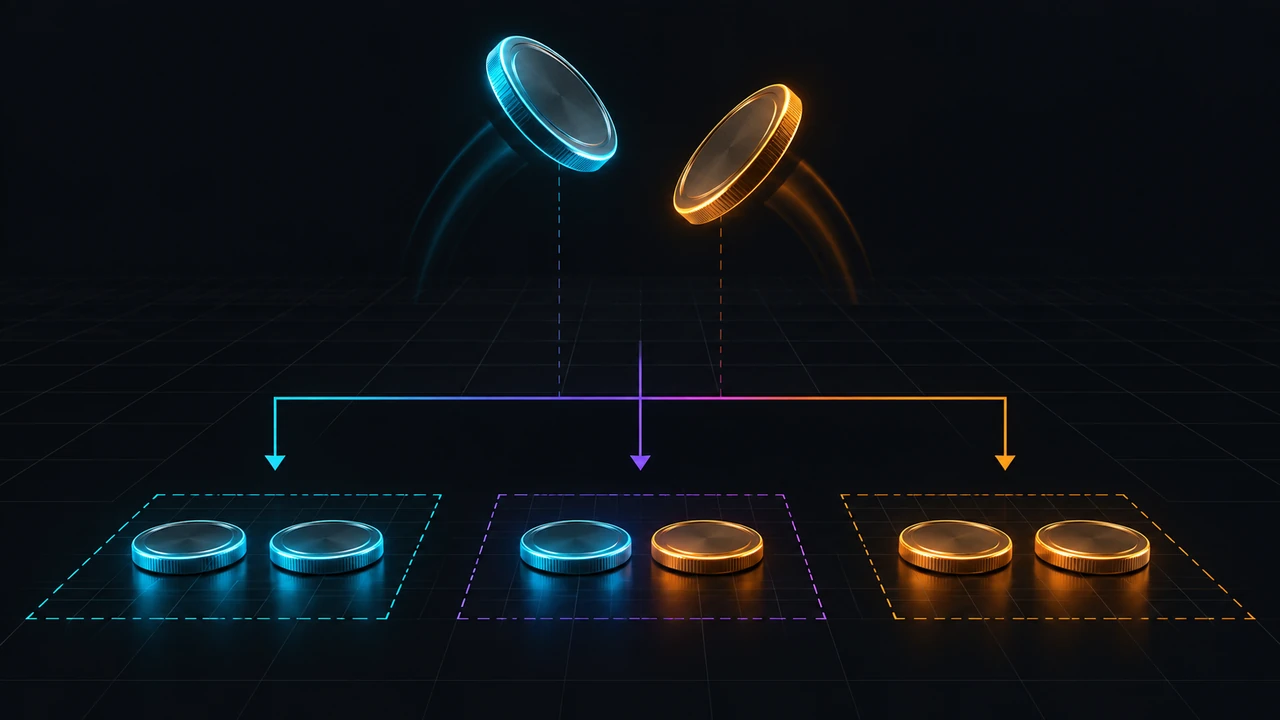
- Coins per spin
- Two, tossed from a kip
- Heads or tails
- One arrangement in four each
- Odds (one of each)
- Two in four — a re-spin
- Casino house edge
- Comes entirely from the five-odds rule
The kip, the ring and who calls a dead spin
The equipment list is short and every item has a job. Two coins, usually pennies, because the pre-decimal penny is heavy, wide and readable at a distance. A kip: a flat piece of wood, sometimes recessed, that the spinner holds in one hand with the coins resting on it. A marked ring, or a designated patch of floor, that the coins must land inside. That is the whole apparatus.
The cast matters more than the gear. The spinner tosses. The ringkeeper, or ringie, controls the coins between spins, hands them over, and calls whether a spin was valid. The boxer runs the game: matching bets, holding stakes, settling disputes and taking whatever cut the game operates on. In a venue game on Anzac Day one person often does both of the last two jobs while a queue of first-timers shout numbers at each other.
A spin has to satisfy conditions before the result counts, and this is where newcomers lose money they thought they had won. The coins must be tossed clear above the spinner's head, both must rotate in the air, and both must land inside the ring. A coin that lands outside, leans against a wall or a shoe, stacks on the other, or fails to turn is not a result. The ringkeeper calls it dead and the spinner goes again. There is no appeal.
Before putting money down, establish whose rules you are playing under. Liquor and Gaming NSW publishes a two-up rules document and a fact sheet, and other state regulators publish their own conditions; a licensed school or a casino table posts its own rule card. That card is the authority for that game, not the version your uncle described at a barbecue.


18+ · Bonus conditions
Offer information supplied: 2026-10-05.

18+ · Bonus conditions
Offer information supplied: 2026-10-05.
Heads, tails and odds: why the fair bet is the whole story
Two fair coins produce four equally likely arrangements: head-head, head-tail, tail-head, tail-tail. Collapse the two mixed arrangements, which are indistinguishable on the ground, and the spin has three named outcomes. Heads is both coins obverse, one arrangement in four. Tails is both reverse, one in four. One of each is odds, also called one them, and at two arrangements in four it is the single most likely thing to happen on any spin.
Here is the part that is usually garbled. In the traditional ring game, odds is not a result. It decides nothing, settles nothing, and the spinner simply spins again. So the question that matters is not what happens on one spin but what happens on the spin that finally decides the bet. Discard every odds spin and you are left with heads and tails, which were equally likely to begin with. The decisive spin is a coin flip in the ordinary sense: half and half.
That has a consequence worth sitting with. A head-to-head bet at evens on a two-up spin, matched between two players, is a fair bet. Expected value is zero for both sides. Nothing else on a gambling floor behaves like that, which is why two-up spent most of the twentieth century illegal rather than licensed: there was no obvious way for a house to earn from it without changing the game.
So the ring earned a different way. The boxer takes a commission, historically a cut of the spinner's winning bets, which is a charge on a transaction rather than a bias in the outcome. Make that the first thing you establish at any game you join: if a cut is taken, how much, taken from what, and when. A commission on winnings only is a different proposition from a commission on every stake. Some jurisdictions restrict charging altogether; the ACT allowance, for instance, is framed around no charge, commission or fee being taken unless proceeds go to charity. A game running an undisclosed cut is a game with an unknown price.
The five-odds rule, and the house edge you can derive yourself
A casino cannot bank a fair game, so the two-up table that appears on an Australian casino floor is not the ring game with a dealer attached. It is the ring game plus one additional rule, and that rule is the entire business model.
The rule is the five-odds rule. The spinner keeps tossing until heads or tails decides the bet, as before, but if five consecutive odds are thrown first, the sequence ends and the house collects the heads and tails bets. The casino also becomes sole banker: you bet against the table rather than against the bloke beside you, and the player-to-player side betting that defines the traditional ring is gone.
Now derive the price, because this is one of the few casino games where you can do it in your head and get the exact answer. Odds has probability one half on any spin. Five consecutive odds, each spin independent of the last, is one half multiplied by itself five times: one in thirty-two. That leaves thirty-one of every thirty-two sequences decided by heads or tails, split evenly, so heads decides thirty-one in sixty-four and tails the same.
Back a head. You win thirty-one times in sixty-four, lose thirty-one times in sixty-four when tails lands, and lose two times in sixty-four when the sequence odds out. The wins and the tails losses cancel exactly. What remains is two in sixty-four, which is one in thirty-two, or 3.125 per cent of your stake. That figure is not a published estimate, a simulation or a review-site claim. It is one divided by thirty-two, and it is the whole house edge on the simplest bet on the table. Establishing the cost of a pokie means hunting for a studio's simulated figure in a help panel; two-up's cost is an arithmetic consequence of one posted rule.
One caution: the five-odds threshold is a rule, not a law of nature. Each additional odds spin the rule demands halves the edge, and each one it removes doubles it. Read the number on the card rather than assuming five.
// sponsored · Safe Casino · 18+
+500% + 120 free spins
Safe Casino welcome offer. Check the qualifying deposit and wagering conditions before you claim.
Pricing the rest of the layout: five odds and the spinner's bet
A casino layout usually offers more than heads and tails, and every extra bet is built from the same five-odds rule, which means you can price all of them the same way. The head and tail bets are the base proposition above: even money, the cost being the sequences that die in odds.
A five odds bet backs the thing the house is hoping for. It wins exactly when the sequence throws five consecutive odds, one time in thirty-two. Price it against whatever the card in front of you pays. Take 28 to 1 as a worked example: one win paying twenty-eight units against thirty-one losses of one unit is a shortfall of three units per thirty-two, or 9.375 per cent — three times the cost of backing a head. What your own table pays is printed on the layout or the rule card.
A spinner's bet backs the person holding the kip to throw a set number of heads before throwing tails or odding out. Work it with the target and the payout the card states. Say the target is three heads and the payout is 15 to 2: each decisive spin must survive the odds counter and then come up heads, so three in a row gives a win chance a little over eleven per cent, and against seven and a half to one the edge lands near three and a half per cent. Slightly worse than a flat head bet, for a proposition that takes three times as long to resolve.
Two things follow. The ranking of bets at a two-up table is stable and derivable, so you need nobody's recommendation. And two cards quoting different odds on the same bet are two different prices — read the one in front of you rather than carrying a figure from anywhere else, this page included.
Figures differ between builds and lobbies. Read the live game's information panel before you rely on any of them.
Play here →Where two-up is legal: three different situations
Three legally distinct situations get called two-up, and conflating them is how people end up running an illegal game in a function room.
The commemorative-day allowance is the one most Australians meet, and each state and territory sets its own conditions. In New South Wales the Gambling (Two-up) Act 1998 permits games on Anzac Day, on Victory in the Pacific Day on 15 August, and on Remembrance Day on 11 November but only after noon; the Act does not legalise play at any other time. Queensland permits it at licensed RSLs and services clubs, or at other licensed venues with written permission from an RSL sub-branch, tied to Anzac Day or another recognised remembrance day. Victoria allows it at pubs and clubs on Anzac Day and at RSL sub-branches across the days leading up to it. South Australia confines it to Anzac Day at RSL or Defence Force premises. The Northern Territory ties it to games run by or for an RSL club. The ACT allows it on Anzac Day with the charging restriction noted earlier. Check your own regulator's current conditions before organising anything.
The year-round schools are the second situation, and there are very few. Broken Hill in far-west New South Wales and Kalgoorlie in Western Australia are the two usually cited, each having kept a school going outside the commemorative days on the strength of local mining history. Whether either holds a current licence, and on what conditions, is a question for that state's regulator and its licence register. Specific arrangements in specific towns, not a general regional exception.
Casino table two-up is the third. A table game inside a state-licensed casino sits under casino regulation, which is the legal room that lets it bank bets and run a five-odds rule at all, and in practice it has been a rarity rather than a fixture. Table games get added and withdrawn without announcement, so if a trip depends on it, check the venue's current table-games listing before booking.
Why two-up barely exists online
Two-up has almost no online life, and the reason is the arithmetic in the five-odds section.
The traditional game has no edge to sell. Putting it online means bolting on a five-odds rule or an equivalent, at which point it is a two-outcome bet with a small built-in cost and none of the ring, the shouting, the kip or the crowd that makes the game worth playing. Strip the social apparatus out and what remains is a coin-flip competing with roulette, which already has a wheel, a layout, decades of recognition and far more bets to sell. Nobody has a commercial reason to build it.
Lobbies carry adjacent things that get mistaken for it: live-dealer coin-flip and head-or-tail side games, dice and wheel show formats, and the occasional Anzac-themed pokie borrowing the imagery without the mechanic. Whether any particular site carries a coin-toss format — Safe Casino and WinCrown get asked about — is answered only by that operator's own live lobby on the day, not by a third-party catalogue, this one included.
Two points of context apply to all of them. Online casino services cannot lawfully be supplied to people in Australia, so any operator reachable from here is offshore whatever currency it displays. And a live coin-flip game is not two-up: it is a different product with its own posted edge, and the figure derived on this page does not transfer to it.
// sponsored · WinCrown · 18+
+500% + 120 free spins
WinCrown welcome offer. Read the current promotion terms, eligibility and withdrawal conditions.
The only two-up decision that is actually arithmetic
Two-up has a very short list of real decisions and a long folklore of fake ones. Sorting them is straightforward once you know where the maths lives.
Start with what cannot work. Successive spins are independent, so a run of five heads does not make tails likelier on the sixth, and the coins hold no record of what they did before. The rules governing a valid spin exist specifically to remove the spinner's influence: tossing above head height, requiring both coins to rotate, and demanding both land inside the ring eliminate the controlled drop or flat flick a practised hand could otherwise manage. A spinner who looks like they are doing something clever is doing theatre.
Now the one piece of conditional probability in this game that genuinely matters. The consecutive-odds counter is the only state two-up carries, and it moves the price of the base bet while a sequence is running. The cost of a head bet is the chance the sequence odds out, which is one half raised to the power of the number of odds spins still required. From a clean start that is five, giving one in thirty-two. After three odds have already landed, only two more are needed, so the chance is one in four. A head bet placed at that moment carries roughly a twenty-five per cent cost instead of three: eight times worse, for identical-looking money on identical-looking felt.
The decision rule falls straight out of that. Find out when the table accepts bets. If betting closes before the first spin and stays closed for the sequence, every head and tail bet is priced at the clean-start figure and there is nothing to think about. If money can go on between spins, a head or tail bet after odds have landed is materially worse, and a five odds bet at that moment is materially better, which is exactly why a well-run table does not allow it. The betting window is the one thing at a two-up table worth checking that is not printed as a probability.
Everything else follows ordinary rules. The cheapest bet is the plainest. Doubling after a loss changes the size of your swings, not the price of the game. And the commemorative-day game is a fair bet with a social function, which makes it the rare gambling occasion where the sensible amount to bring is the amount you are content to hand to the bloke beside you.
What this page could not verify
No payout schedule is reproduced here as current. The 28 to 1 and 15 to 2 figures are illustrative numbers used to demonstrate the division, not a claim about what any table pays; a different card gives a different answer, and redoing it takes under a minute. The five-odds threshold, the heads required for a spinner's bet, the betting window and the treatment of a dead spin are all venue rules, and this page explains how each changes the price without asserting what any venue currently runs.
The legal summaries describe published state and territory positions on commemorative-day play and the two towns usually cited as keeping a school year-round. They are not legal advice, they are not exhaustive, and they can be amended. Anyone organising a game should read their own regulator's current conditions, including anything on commissions, venue type and permissions.
Nothing here verifies that any online operator carries a two-up or coin-toss format, and no operator mentioned is licensed in Australia, because online casino services cannot lawfully be provided to people here.
Questions people actually ask
What are the rules of two-up in Australia?
A spinner tosses two coins from a flat wooden kip, clear above head height, and both coins must rotate and land inside the marked ring. Both heads is heads, both tails is tails, and one of each is odds. In the traditional ring game odds decides nothing and the spinner simply goes again. The ringkeeper calls any spin that fails those conditions dead.
What are the odds of heads in two-up?
On a single spin of two fair coins, heads is one arrangement in four, tails is one in four, and odds is two in four. Because odds is a re-spin rather than a result, the spin that actually decides the bet is an even-money proposition: heads and tails were equally likely to start with, so discarding the odds spins leaves them equally likely at the finish.
What is the house edge in casino two-up?
On the simplest head or tail bet it is exactly one in thirty-two, or 3.125 per cent, and it comes entirely from the five-odds rule. Five consecutive odds is one half to the power of five, which is one in thirty-two, and when that happens the house collects the heads and tails bets. Confirm the threshold on the table's rule card, because a different number changes the figure.
Is two-up legal in Australia?
Only in defined situations. Each state and territory permits it on commemorative days under its own conditions, typically Anzac Day and usually at RSL or licensed premises. Broken Hill and Kalgoorlie are the two towns usually cited as keeping a school going year-round, and the current licence conditions there are a matter for the relevant state regulator. It has also appeared as a table game inside state-licensed casinos. Outside those situations it is not legalised, so check your own regulator before organising a game.
Can you play two-up online?
There is almost nothing to play, and the reason is commercial rather than technical. The traditional game has no built-in edge, so a studio would have to add a five-odds rule or similar, leaving a bare coin flip that competes with roulette and sells fewer bets. Lobbies carry live coin-flip and head-or-tail side games instead, which are different products with their own posted edges.
Is there any strategy in two-up?
Only one thing is genuinely arithmetic: when the table accepts bets. The consecutive-odds counter is the game's only state, and a head bet placed after three odds have already landed carries roughly a twenty-five per cent cost rather than three, because only two more odds spins would end the sequence. Patterns in the coins themselves do not exist, and the valid-spin rules are designed to remove any skill from the toss.
// next step
A paytable makes more sense with the game open in front of you.
View current offer